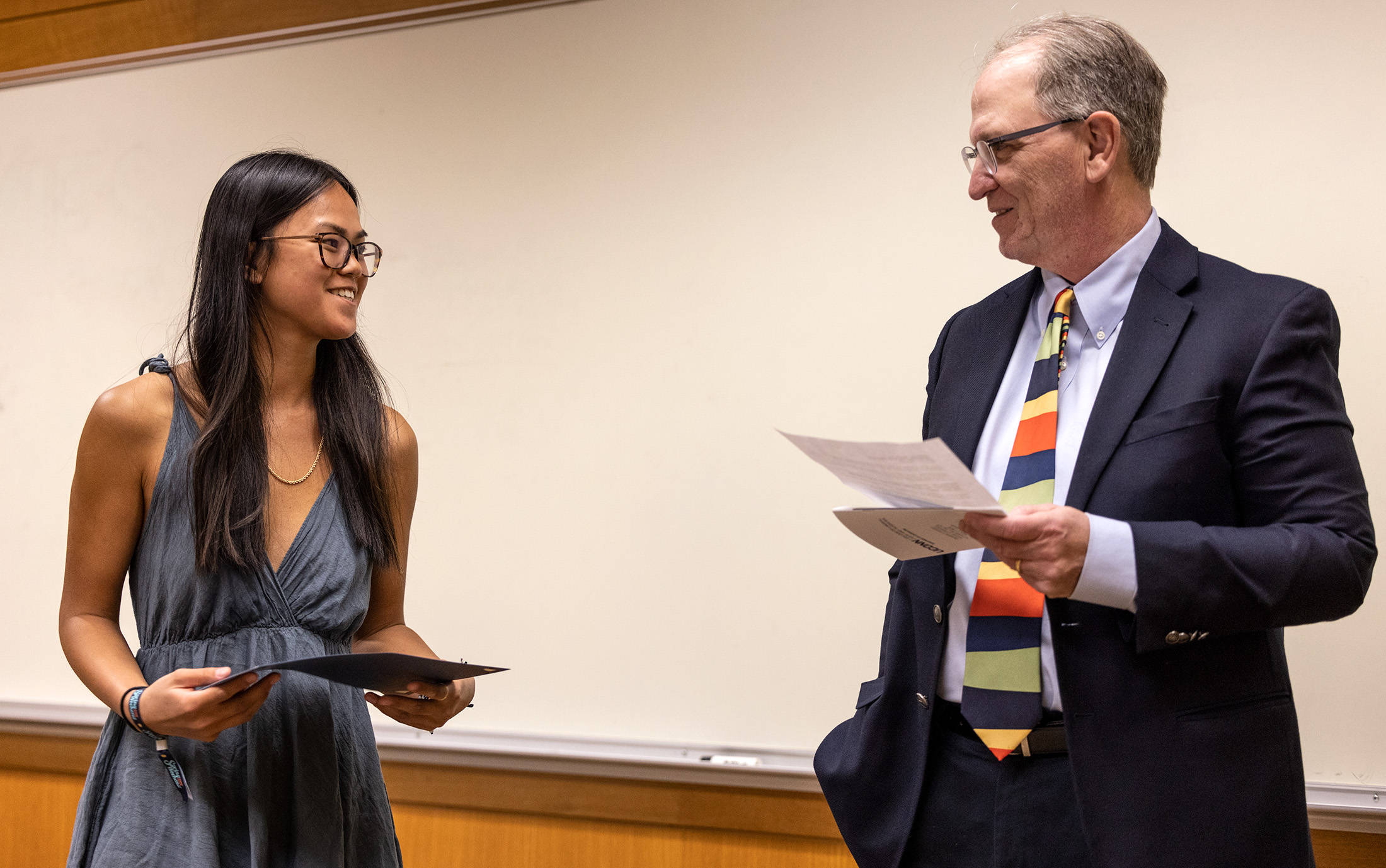
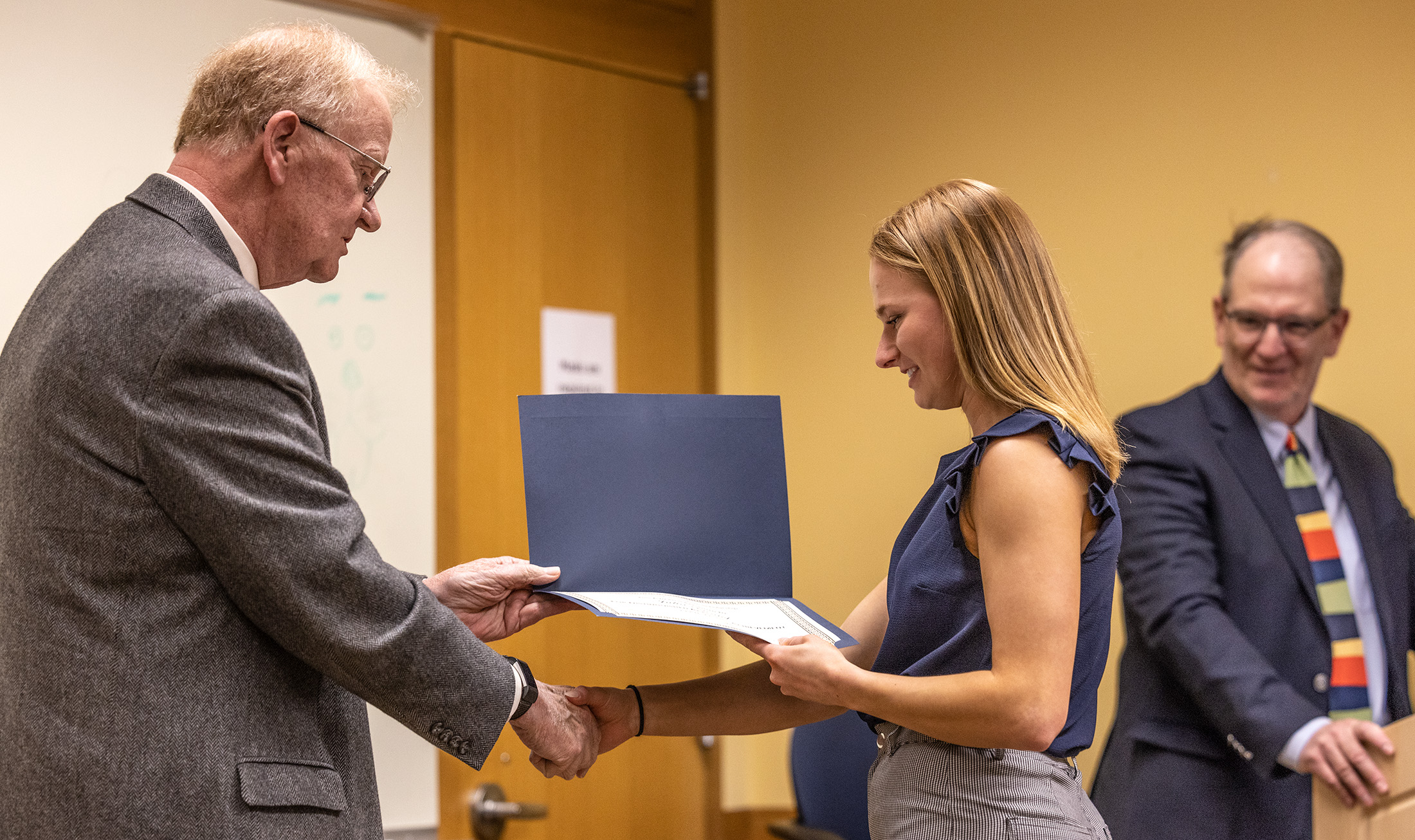
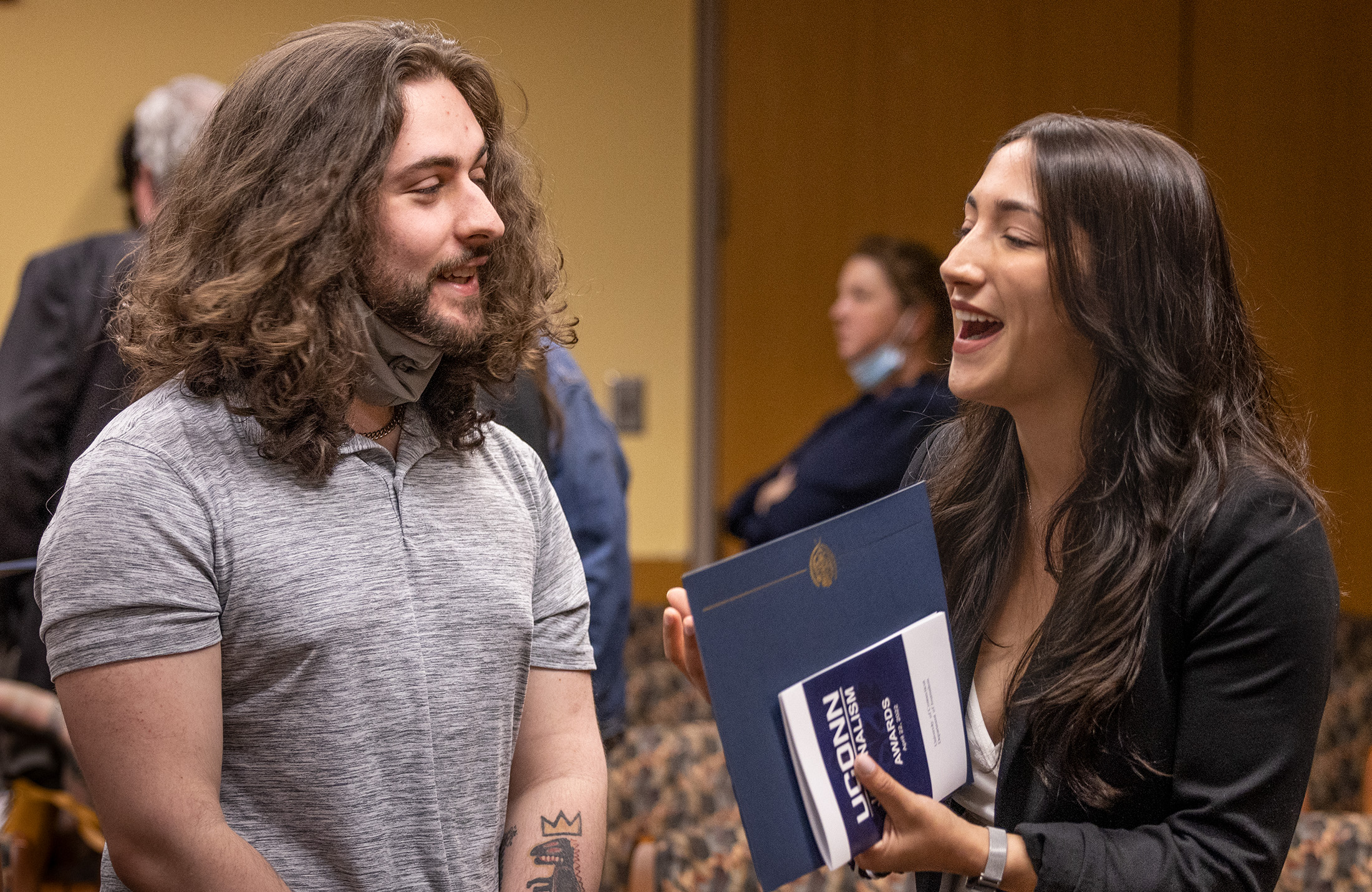
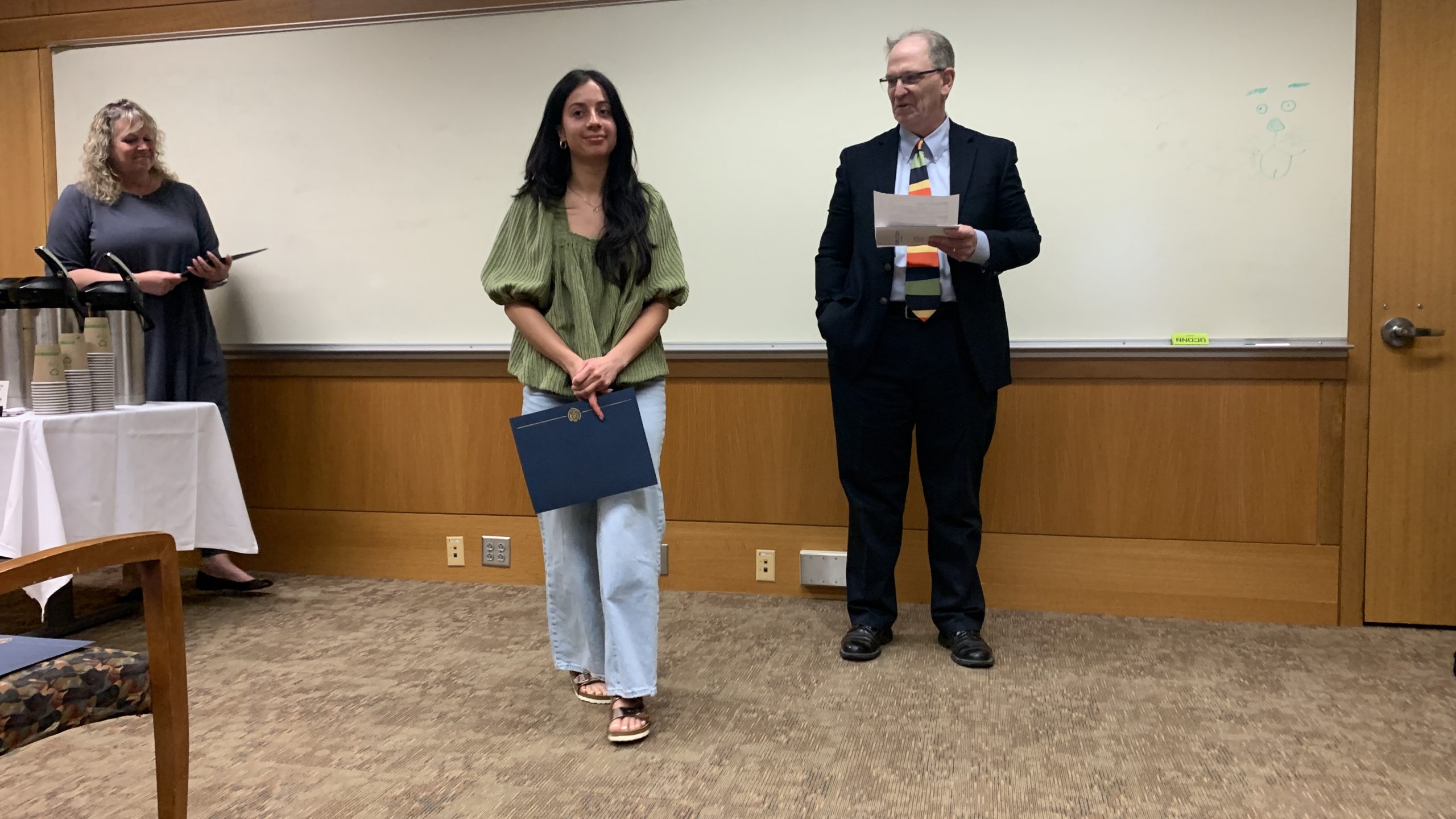
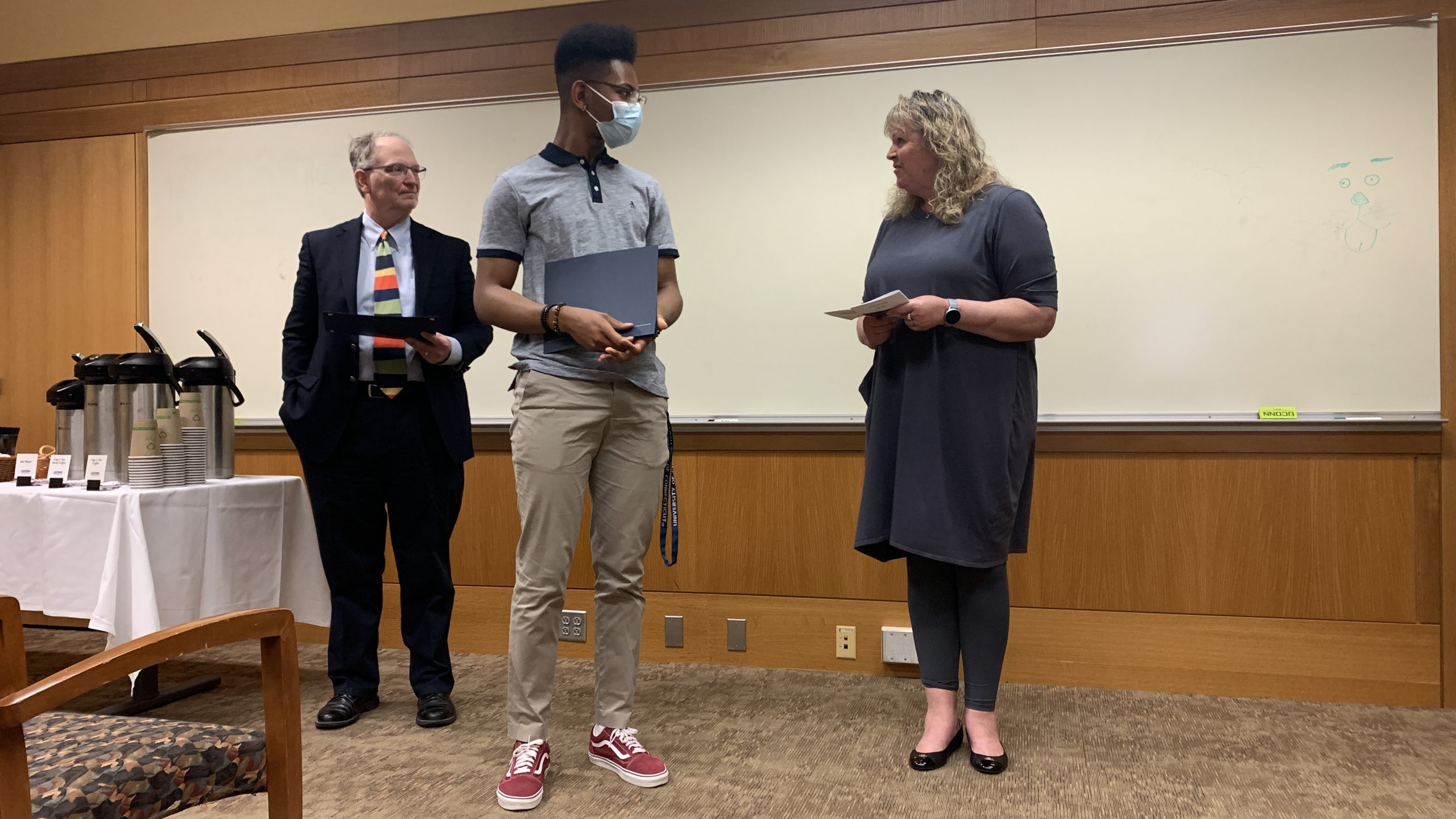
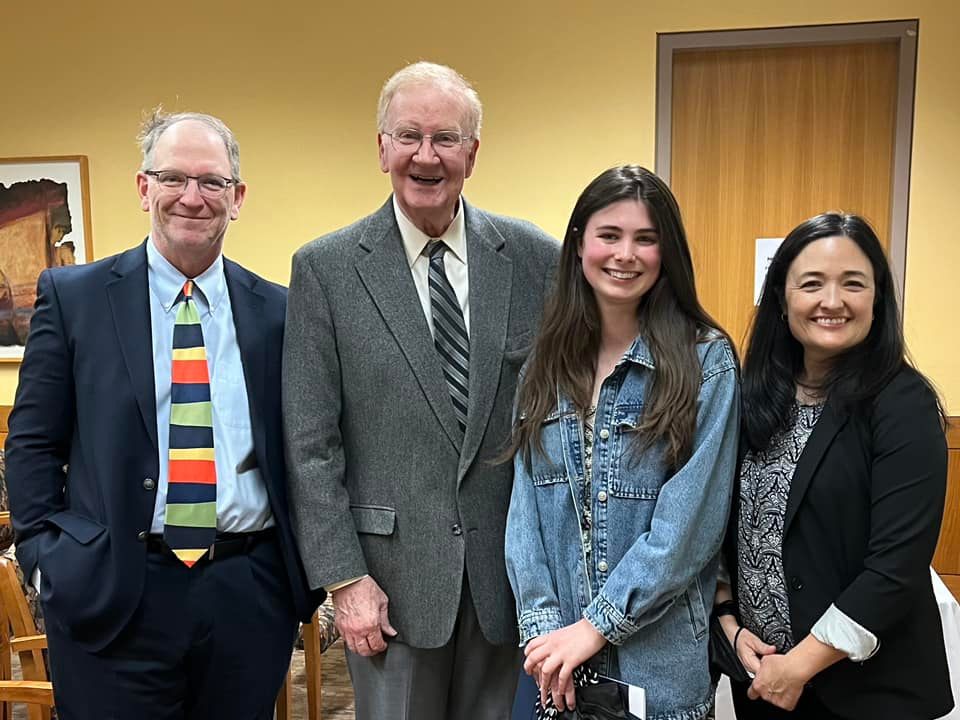
It has become a UConn Journalism Department tradition that when a faculty member retires, they give "The Last Lecture" at our annual student awards ceremony. Here is the lecture delivered on April 22, 2022 by Professor Emeritus Maureen Croteau, who retired in August 2021 after serving as department head of UConn Journalism for 38 years.
 Why you went to college.
You've got to hand it to me. I've got a lot of nerve to stand here and pretend to tell you why you went to college.
You would seem to be the expert on that.
Still, in 38 years of teaching, I have listened to a lot of students, and I have learned a few things.
So, I will hazard these guesses about what brought you to college:
- There was no Grade 13.
- Everybody expected you to go, so you went.
- You didn't yearn for a fulltime job at the car wash.
- Your family would have killed you if had done anything else.
- You had heard about the parties.
- And, of course, you wanted to learn something – preferably something that would get you a job that didn’t involve a hose and a squeegee.
So, you ended up at UConn, and now you are about to graduate. Which would seem to be the end of the story . . . which would make this a very short lecture . . . but, of course, you know that lectures are never that short.
It has been very hard for me to put this speech together. The idea of the “Last Lecture” is a bit grim, and it is not something to which I have looked forward. Journalism, students, and this university are important parts of my life. Now that I am retired, I find that I dream that I am teaching.
When I arrived at UConn as a freshman in 1967, I would not have predicted that any of that would have been true. I was in pre-med. But a semester of microbiology, bacteriology and calculus convinced me that I was not exactly a natural. So, I switched to psychology, intending to get a doctorate there.
Journalism was not on my radar. In fact, Journalism was not yet a major. But there was a tiny department, with four courses and two exceptional faculty members, and I had heard good things about it. So, I made an appointment to meet with the department head, Evan Hill, to find out more. He asked me my GPA. I told him rather proudly. He told me not to take any journalism courses because they would wreck my average.
Of course, I signed up immediately -- and my life changed forever.
That, as it turned out, was one of the reasons I went to college. I thought I had gone to college to become a doctor. Instead, I went to have my mind changed. To try new things. To learn the difference between what I could do, and what I would love doing. I suspect that many of you have had the same experience.
We go not just to get a job, but to have the privilege of doing a job that matters to us. Most of the world does not get that. My parents certainly never had that, and no one ever asked my grandfather if he loved operating the drop forge in an ax factory. I once worked in a blender factory, screwing the legs on blenders as they came down the production line. I was terrible at it. Nobody loved that job, but there were lots of women who did that job year after year because it paid the rent. I had deep respect for them, but I did not want to be them.
Being able to do a job that you love, and that matters to you, is a rare privilege. That is certainly one of the reasons I went college, although I’m not sure that I would have said that at 18.
Looking back, I am very grateful that for 50 years I have worked at jobs that I loved. And I am surprised at how different those jobs have been from the jobs that were available when I graduated. When I started working as a reporter, personal computers did not exist. There were no cell phones. It was important to keep a pocketful of dimes so that you could dictate stories on deadline from pay phones. When I came to UConn as department head, we had no computers. Cameras used film. Students typed on manual typewriters and used carbon paper to make multiple copies. (Some of you who do crafts may know what carbon paper is.)
Evan Hill used to say that his goal was not to prepare students for their first job, but for their fourth or fifth job. At the time, all I really cared about was getting my first job. But UConn taught me to write, to tell a story, to question authority, to verify information, to work ethically and to work in the public interest, which I have done ever since.
Most importantly, it also taught me to learn, which is what prepared me to be where I am today. We have done the same for you. I understand that, now, in ways that I didn’t before. That is one heck of a good reason to go to college.
I grew up in a factory town, and my parents' big dream was for their daughters to have more than they did. Some of their friends told them that it was foolish to spend money educating girls, because daughters would just marry and have children anyway. Luckily, my parents did not share that belief. If they had, I would not be giving this lecture today.
I was 11 years old when I saw UConn for the first time, and it was the most wonderful place I had ever seen. There was a library with a gold dome (not the current library), and a football stadium (not the current football stadium)and one whole building just for life sciences. We needed a map to find our way around.
My oldest sister was coming here as a freshman, which was nearly beyond my imagining. She was the most beautiful, most sophisticated, most intelligent young woman I had ever known. I could hardly believe that anyone so special could be my big sister. And she would be going to UConn. I spent that summer redeeming bottles that I found along the road, wheeling them in a cart to the grocery store near us, saving up enough to buy her a metal gooseneck desk lamp that held two plastic pens. (The pens also had little rulers built into the handles, in case you wanted to measure your mail, I guess.) All three of us used that lamp eventually.
At the time, tuition, room and board were about $500 a semester, not counting books and other expenses. That's about $4,300 in today's dollars. (I did what we always tell you to do and looked it up.) My first year at UConn cost my family $1,500. My mother, a hairdresser, was earning about $3,000 a year before taxes. With what was left after taxes, she bought her uniforms (all hairdressers wore uniforms at that time) and paid for a ride to and from work. The rest of her paycheck went to pay for us to go to college.
All of this seems like yesterday to me, but of course it was not. Many things were different. For example, I did not look like this. I had long, straight hair, which was more or less a requirement for folk singing. I also had a guitar, which was another requirement. I wore fringe. It was the 1960s and 1970s. We all wore fringe. Homer Babbidge was not a library. He was the UConn president, and a very nice man. The Daily Campus sent a reporter to cover the Vietnam War. Richard Nixon was president. Bob Dylan was singing "the times, they are a changin'." Of course, I was singing “the times, they are a changin’,” too. That was another requirement of being a folksinger.
And Bob Dylan was right. I know that you have all weathered the college's extensive General Education Requirements – like it or not. So, I am quite comfortable talking to you about how society has changed during my lifetime, and how that has contributed to why going to college seemed like a natural choice for many of you.
When I was born, college was definitely not an expectation. At that time, only 5 percent of people 25 to 34 had a college diploma. Nearly half of those 25 to 34 had not graduated from high school. By the time I graduated from UConn, only about 16 percent had a college diploma, but graduating from high school had become the norm.
By the time you came here in 2018, about 39 percent of people 25 to 34 had a college diploma, and only about 8 percent did not have a high school diploma. So one of the reasons you went to college was that you were supposed to. As a society, our expectations had changed. And although you could not see it at the time, there was a social stream that was carrying you along.
Were you all carried equally? Absolutely not.
The College Board produces extensive research on who goes to college, and you will find no surprises there. If you grew up poor, if your parents did not have an advanced education, if your school system was substandard, if your first language was not English, the stream did not carry you as readily as it carried others. Is this the embodiment of the American dream?
I will leave that question for you to ponder because -- as it turns out -- that, too, is one of the reasons you went to college. You came here to learn to question beliefs, to think independently, to recognize injustice and to have the tools that you need to change the world. I am sure that you know that already. I'm just reminding you now because you are at the point in your lives where you will be making lots of decisions, and those decisions will affect not only you, but others.
Do you remember that social stream that carried you to college? You are now in charge of where that stream goes. That is certainly one of the reasons you went to college, and it is an important one.
I believe that there is a force for good in the world, and that anyone can be part of that. You don’t need a college degree to work for justice, to show compassion, to be kind. But, for those of us who were fortunate enough to attend college, I believe there is a responsibility to use what we have learned as a force for good.
In journalism, this happens all the time. I was once fortunate to tell the story of an intellectually disabled man who had been locked in a ward for the criminally insane for 25 years because he had stolen a car as a teenager. With no family to care about him, his case was never reviewed. Because of a newspaper story, he was released to a group home, where he was free to go on walks, to take shopping trips, go to the movies and have friends. What I learned here allowed me to make that difference in his life.
I have never won a Pulitzer Prize, but my students have. And one of them, who won a prize for stories about women who were victims of domestic abuse, had the kindness and grace to write me a note when he won the award, to tell me that he would not have gone into journalism if not for me. He was just about to graduate, with no professional experience, and he was going to take a job doing landscaping. I knew that he was incredibly talented, with a great heart, and that he needed to be sent in the right direction. I told him that I would not allow him to leave UConn without an internship, and I set him up in a reporting job for the summer after he graduated. He has been a journalist ever since.
What I learned here allowed me to make a difference in his life. And what he learned here allowed him to make a difference in the lives of so many others.
It is not easy to get a college degree. For some of us, it is much harder than for others. Worldwide, only about 8 percent of adults have such a degree. In many countries, even attending primary school is an impossible dream. In Niger, only about 25 percent of children attend school.
So why did you go to college? My feelings will not be hurt if you tell me that you heard that the parties were really great.
But I trust that now that you have a degree, you will also have learned that a very important reason for getting a good education is to recognize that there was more to it than you realized at 18. There is a force for good in the world – and what you have learned here can allow you to be an important part of it.
———
Maureen Croteau was the first woman to lead an academic department at UConn’s College of Liberal Arts and Sciences and was its longest-serving department head. Through her leadership, UConn Journalism has become New England’s only nationally accredited journalism program. She is a graduate of UConn and the Columbia Graduate School of Journalism, the co-author of two books, and a director of The Day newspaper in New London. In 2014, the New England Newspaper and Press Association named Croteau the New England Journalism Educator of the Year. She was inducted into the Connecticut Journalism Hall of Fame in 2017.







 After her top-10 finish in the 10K final at the 2021 Olympic trials, Emily Durgin ’17 (CLAS), who won nine American Athletic Conference individual championships at UConn while earning her journalism and communications degree, decided to take it up a notch.

 Why you went to college.