Author: UConn Journalism

Photojournalist Steven G. Smith announces retirement as UConn professor, documents America during 250th anniversary

By Lily Goldblatt, UConn Journalism
June 4, 2026

As the United States approaches its 250th birthday, the country has never been so divided. Polarization and political tensions are at an all-time high, and Americans seem to have lost sight of one another’s humanity. 

Steven G. Smith, a Pulitzer Prize-winning visual journalist, is disturbed by this trend.  

“Lots of times we can ‘other’ people, and we can think ‘Oh, they’re different than us.’ But the reality is, they’re really not,” Smith said. “In the end, we’re all humans, you know, and I think kindness is overlooked, and I think civility is overlooked, and that’s kind of heartbreaking to me.”

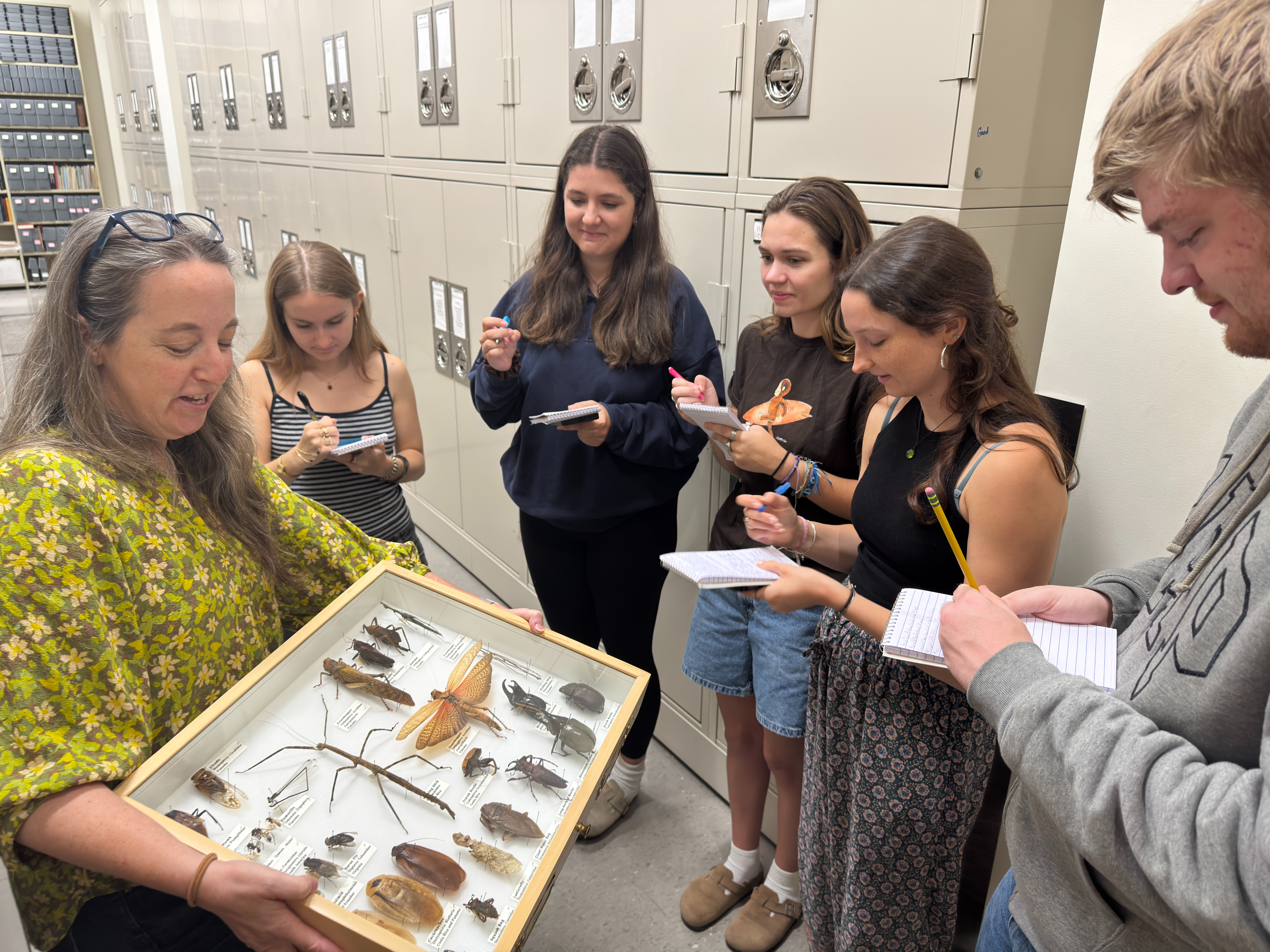
Drum and Bugle Corps, Gebo Cemetery, Montana. Book cover by Steven G. Smith.

Smith, who won the prestigious Carnegie Fellowship award in April 2025, has announced his retirement from UConn after 13 years as a journalism professor. He plans to continue to work on his long-term documentary photo essay “We the People,” which explores American identity in the 21st century at the nation’ssemiquincentennial. 

Smith was born in Kansas City, Missouri. but his family moved to Washington state after his father, a school administrator, took a job there. His mom worked odd jobs but was mostly a homemaker. When Smith was in elementary school, the family moved again, this time to Africa. This would be a formative experience in regard to his future career as a visual journalist. 

“Where we were at was an area that really celebrated the visual arts and storytelling,” Smith said. 

After two years in Africa, the family returned to Washington.  

Smith would meet his wife, Gwyn, while attending Eastern Washington University, which he entered as an engineering major. 

“I had like an internship doing drafting and doing kind of mechanical engineering work,” Smith said. “It just didn’t feel like it was for me.” 

Smith switched his major to photography after taking a photography class that he loved. He then found his college newspaper and took several journalism courses.   

After graduating in the mid 1980s, he worked as a staff photographer for a number of publications. 

One of his first major stories involved documenting the reintroduction of the gray wolf into Yellow Stone National Park in the mid-1990s for the Billings Gazette, a controversial event due to concerns about the ecosystem in the area. 

“I was able to photograph when they first brought the wolf back in and, you know, where they actually kept the wolf in a captive pen for the first winter,” Smith said. 

In 2002 Smith photographed wildfires in Colorado for Rocky Mountain News and won a Pulitzer as part of the newspaper’s team.  

In addition to his own photojournalism, Smith has also enjoyed teaching photography.  

“My father was a teacher, and I had siblings in education, so it was always potentially at the back of my mind,” Smith said. “I enjoyed sharing and was passionate about what I was doing.” 

In 2013, Smith became a journalism professor at the University of Connecticut, along with fellow Pulitzer Prize winner Mike Stanton. In 2018, the two published a story following a retirement home fan club for the UConn women’s basketball team as they attended a game at Gampel Pavillion. Stanton wrote while Smith took pictures. 

“He’s very diligent,” Stanton said of Smith. “People that don’t understand photojournalism, you know, think that you just take the camera and point and shoot. But it’s really about building relationships and building trust.” 

That same year, Smith published his book “Under the Dark Sky: Life in the Thames River Basin,” which chronicled the communities in Connecticut and Massachusetts in what has been coined the “Quiet Corner.” It’s considered to be one of the last places where the dark night sky can be viewed on the East Coast. 

Smith described the idea for the book as somewhat selfish in that it originated from his desire to know the community better.  

“There’s no better way to get to know the community than to do a broad reaching story like that,” he said.  

Kate Farrish, an assistant professor in residence in UConn’s journalism department, helped edit captions and provide suggestions for Smith’s book. 

“It was great fun to work with him on it because, I mean, he’s so talented,” Farrish said. “His photography is so beautiful. I just wanted to try to get the words to match.” 

Being a native to Northeastern Connecticut, Farrish was able to provide some institutional knowledge about the area. 

She recalled a conversation with Smith where he asked about the birds in New England and asked why they were tweeting so early in the morning.  

He revealed that out West, the birds didn’t do this.  

“I’ve only lived here and he’s lived all over the place. It was something he’d noticed that I’d never really noticed,” Farrish said.  

In 2022, Smith released a documentary “The Long Goodbye,” which followed a daughter caring for her father with Alzheimer’s.  

The film, which was screened at the Cannes World Film Festival, involved gaining an intimate level of access into the daily life of this family in order to tell their story of dealing with this debilitating illness as accurately as possible.  

“You can always do stories in ways that are just, you know, interviews, talking heads, but those stories rarely have a great deal of impact,” Smith said. “It’s far more impacting, the opportunity to show what this caregiver is going through, and this is particularly true from the visual side of journalism.” 

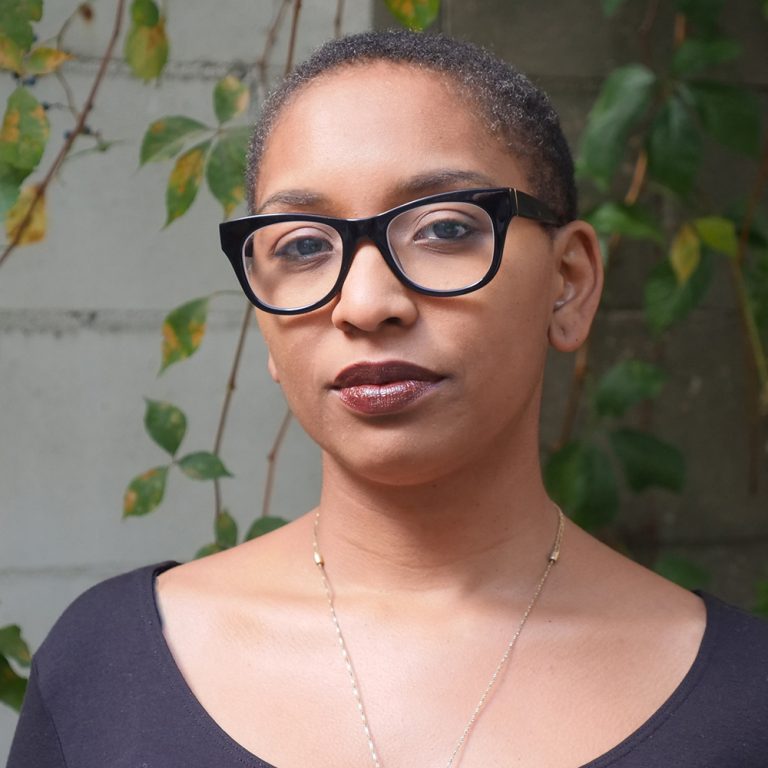
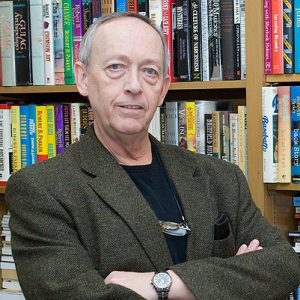
Headshot of Steven Smith.
Journalism Professor and Photojournalist Steve G. Smith will retire from UConn in September 2026. Contributed photo.

In 2025, Smith received the Carnegie Fellowship for research focusing on subjects related to political polarization for his photo essay “We the People.” 

“He was chosen among his peers at UConn and then, you know, among his broader peers nationally to get this. It’s a pretty big deal,” Stanton said.  

With his grant of $200,000 from the fellowship, Smith has embarked on a journey across the United States to explore all facets of American cultural identity and life.  

Through the project, he hopes to show Americans what lies outside of their corner of the country during this divisive time.  

“I travel, I photograph, I meet a lot of people, right? And I hear the polarization and it’s disturbing to me,” Smith said. “I guess the idea and the concept is, you know, ‘Hey, this is our country, this is the people that live here.’”  

So far, he’s visited about 38 states and has been working almost non-stop. In a single week he’ll visit up to 10 events to photograph. 

“I’ve been a traveling fool, and I am exhausted right now,” Smith said. 

Recently, he was in Louisiana for five days, where he photographed everything from festivals to beauty pageants. 

“Those community festivals can be very interesting because they really take on very specific cultural things from a particular area,” he said.  

One event involved a tomato festival and a pageant to crown “Miss Tomato.” 

He explained that lots of times, festivals, such as the tomato festival in Louisiana, are tied to the agricultural roots of the community.   

“I like the history part of it,” Smith said. “Like, oh, I didn’t know they grew tomatoes in that part of Louisiana. And it’s like oh, that makes sense. I mean there’splenty of hot weather.”  

Little Bighorn Battlefield National Monument
Native Americans gather at Little Bighorn Battlefield National Monument to honor ancestors who fought in the 1876 Battle of Greasy Grass, a victory for the Lakota, Cheyenne, and Arapaho over the US Cavalry (Photo courtesy of Steven G. Smith)

Smith recently announced his retirement from teaching to work on his project and move back West to be closer to his family. 

“I love teaching, you know, impacting the future of your field. I think that’s quite an opportunity,” Smith said. “I certainly enjoy my field a great deal so it’s a funny Catch 22 for me because I enjoy doing both.” 

According to Stanton, Smith has enriched the department through his experience in the field.  

“The thing about when you’re a professor and you’re in the classroom, but then you’re out in the field doing your work, the two don’t seem connected, but they are because you know, you bring your experiences into the classroom and vice versa,” Stanton said.  

Farrish, who’s known Smith since he joined the department, said while she’s happy for him and his family, she’s sad to see him go and knows it will be a big loss for the UConn journalism department. 

“He’s such a talented journalist, he’s such an extraordinary photographer, but he’s also a wonderful colleague,” Farrish said.  

2026 UConn Journalism award winners and scholarship recipients

As the Spring 2026 semester wrapped up, the UConn Journalism Department handed out thousands of dollars of scholarships and honored 20 of our journalism majors at our annual Scholarship Awards Ceremony last week.  The students were honored for their achievements both inside and outside of the classroom.

An impressive alumna of our program, Jackie Wattles, who covers space and science for CNN, returned to Storrs to be our keynote speaker.  She also spoke to Prof. Kate Farrish’s two Newswriting classes. She told the students that UConn is where she fell in love with the journalism process, including the discipline of verifying all facts and setting aside your biases. “Studying journalism is a way to train your brain,” Wattles, who is just back from covering the Artemis II mission to the dark side of the moon, said. “It’s craft, and it’s a profession.”

Pictured: The scholarship recipients, back row, from left: Maleena Muzio, Kaden Knapp, Thaddeus Sawyer, Jake McCreven, Dan Stark, Sydney Haywood, Sophia Makin, Julianna D’Addona, Avery Becker and Karla Perez.
Front: Gianni Salisbury, Kitan Arole, Erika Avellino, Amanda Gonzalez, Katie Servas, Mikayla Bunnell, Dannan Page and Isabelle Camerato. Not pictured: Charlotte Harvey, Anna Heqimi and Elijah Polance.
Others: Wattles, Farrish and journalism student Mak Blake
Photos by UConn journalism student Gavin Foster

Evan Hill and the Rise of UConn Journalism

By Ben Gingold | UConn Journalism
May 2026

During Evan Hill’s tenure as a professor and Journalism Department head at the University of Connecticut, he was known by his students as a stern man who had no tolerance for tardiness.

“Evan was a stickler for a lot of things, including showing up on time,” recalled Steve Hull, a UConn alumnus who went on to work at The Day newspaper in Connecticut and become founding editor and publisher of Bethesda Magazine in Maryland. “If you were 10 seconds late, he would knock on the door, he would wave at you, and then go back to teaching. And you were left out there in the cold.”

Beyond the papers riddled with editing marks that Hill was also known for, was a man who truly cared for his students both inside and outside of the classroom.

“He'd be so tough on them in class and send their papers back to them covered with red ink, and then he'd invite them to his house,” his daughter Lucinda Hogarty said. “My mother would make this huge pasta dinner that we used to call slumgullion … and all the students would just crowd in our living room and have a good time.”

Hill became UConn’s Journalism Department head in 1965 at then-UConn President Homer Babbidge’s personal request. Hill helped create the journalism major in 1979, and his legacy and teaching remain core values of UConn’s journalism program.

Hill was a war veteran, a seasoned reporter and a skillful educator. He graduated with a bachelor's degree from Stanford in 1948 and a master's degree from Boston University in 1950 before ending up at UConn. Hill died on April 10, 2010. He was 91 years old.

“Once you got over being terrified of him and intimidated by him, you could learn a great deal and realize that he very much cared for his students,” Hull said. “He taught me beyond how to be a journalist, just the value of hard work and of integrity in your work.”

In 2010, the Evan Hill Fund for Excellence was founded to support UConn Journalism. The Evan Hill Fund is an endowed donor fund that directly supports the growth of the Journalism Department.

The fund enables the Journalism Department to invite guest speakers, hold student events and help pay for travel and general programming. The idea is to continue Hill's legacy of journalistic excellence by providing aspiring journalists with the tools necessary for their success.

Embarking on the Adventure of a Lifetime

From an early age, Hill took an interest in writing. Hill's father worked at an Alaskan salmon cannery and was a writer in his free time. He wrote numerous books detailing the many things he saw in his time in Alaska.

“My father knew about that, and my grandfather talked to his kids quite a lot about it,” Hogarty said.

These stories not only would inspire Hill to take up writing himself, but would create a lifelong bond with Alaska and its people.

One summer, Hill decided to leave his high school in Bellingham, Washington, and go on the adventure of a lifetime. Salmon canneries often would recruit high school students in his area for work, and Hill jumped on the opportunity.

Hill spent three summers working in the canneries of Alaska, according to his daughter, slowly falling in love with both the 49th state and the people who lived there. After a few years of college in Washington state, Hill decided this path was not for him. He dropped out of school and headed back to the place he knew best: Alaska.

In Juneau – a town small in population but enormous in land mass – Hill would come upon his first job in journalism. He started as a beat reporter for a local newspaper and steadily moved up the ranks. This was a high-stakes, fast-paced environment, with Hill working under rigorous editors who wanted the facts fast and accurate. There, he would begin to flourish, with Hill's time in Alaska a formative experience that served as the backbone of his future journalistic prowess.

“It really did shape him,” his daughter said.

A few years later, Hill would join Alaska National Guard during a time when Alaska was still a U.S territory. With the onset of World War II, the National Guard was federalized and Hill was now part of the infantry.

Before he knew it, he was serving with the 79th Infantry Division on his way to France. In his short time in the Army, he rose from an infantry enlistment to captain of his division. In 1944, he would suffer a severe leg injury, leading to his honorable discharge.

“He took shrapnel to his leg in France and was sent home. He didn't lose his leg, but it was a problem for the rest of his life. He had a pretty bad limp,” Hogarty said.

Hill, now a Purple Heart recipient, was sent back to California to be close to his family during a lengthy recovery process, Hogarty says. “He was inpatient for two years, and then he was an outpatient for another two years getting rehab, but there were a lot of setbacks.”

Hill never forgot about his years in Alaska. He would spend the next few years making visits to Alaska to visit his old war buddies, Hogarty says. During one of these visits, he locked eyes with a young Priscilla Fiske, who was serving as part of the U.S Coast Guard. They quickly began to bond, and got married in the summer of 1946.

When the war was over, Hill went to Stanford University on the G.I Bill, graduating with a bachelor of arts degree in 1948. During his time at Stanford, Hill would take numerous classes taught by the American novelist Wallace Stegner, which helped develop his prowess for narrative writing.

“He talked about the color – you know – bringing color into your stories so people can picture it. He said to be direct, be succinct, be factual, but also have the language carry you along with the story,” his daughter said.

The family moved to Newport, New Hampshire, and Hill served as an editor of a weekly paper. In 1950, he earned his master’s degree in journalism from Boston University. Hill would spend six years teaching at his alma mater before a brief stint at Ohio State University. Hill moved back to Newport in 1957, where he would find work as a freelance writer for numerous magazines.

“Before he went to UConn, the bread and butter in our family, what he was earning money doing, was cover stories for the Saturday Evening Post,” Hogarty said.

The magazines of the 1960s were very different than today’s cultural zeitgeist of celebrity gossip. In this era, magazines were often long, narrative-driven pieces that gave an in-depth look into a topic. Each story would take Hill months to complete, with endless hours being poured into interviewing sources and digging through documents, his daughter recalls.

“He would be assigned a story once every six months or so, and it would be six months’ worth of travel and research. And one, I remember, was about American medicine, the state of American medicine. So, talked to medical students, hospitals, and the American Medical Association, and compared it to other countries. Tons of research,” Hogarty said.

One morning in 1965, Babbidge, who was at that time UConn’s president, drove from Connecticut to New Hampshire unannounced and showed up on Hill's doorstep. Babbidge pleaded with Hill to come work with him to establish a journalism program at his university.

Hill took up Babbidge on his offer. Before Hill's involvement, journalism at UConn was overseen by the university’s chief of communications.

“I think Homer gave him a lot of leeway in what this department was going to look like, and Dad made sure that there were rooms. I mean, think about this, this was in 1966. One of his classrooms was a room filled entirely with manual typewriters,” Hogarty said.

During this time, journalism wasn’t a major at UConn, but a minor field of study. And while only a few rudimentary journalism classes were offered, that didn’t stop Hill's early students from going on to achieve great things.

“It was a small program, two full-time faculty members, but led by two extraordinary faculty members,” said Maureen Croteau, or – as Hill would call her when she was his student – “Ms. Croteau.”

During his time as department head, Hill was heavily involved in the student newspaper The Daily Campus and ruled with an iron fist.

“The first time I met him was in the spring at The Daily Campus banquet,” Hull, his former student, recalled. “The editor took me over to meet him, and when I went over, the editor introduced me, Hill turned around and said, ‘Mr. Hull, you libeled more people in one semester than I did in my entire career.’”

Despite his abrupt manner, Hull recounts that Hill was “one of the two or three most influential people in my life.”

Marla Romash was a student field hockey player when she met Hill. She was fed up with a lack of coverage and marched down to The Daily Campus. When she confronted Hill, he told her, “If you want coverage, you've got to do it, you’ve got to write it.” Less than a year later, Romash was co-sports editor at The Daily Campus.

“He did more to make me see myself as a journalist and see myself in the world than I think anybody else,” Romash said.

Kate Farrish is now an assistant professor-in-residence in UConn’s Journalism Department, but 45 years ago, she was sitting in a chair next to Hill anxiously awaiting his feedback. Farrish was one of the first students to receive a journalism degree from UConn, and credits Hill with the department’s success.

“He’s really the architect of the department, the founder, and was the driving force,” Farrish said. Farrish worked alongside Hill on her honors thesis and was no stranger to his exacting nature. She now sees herself revisiting many of the same assignments that trained her to be a journalist.

“More than 40 years later, I’m still teaching the same thing,” Farrish said. The most memorable of these assignments is known as “sudden death.”

In these sudden-death assignments, first-year journalism students are tasked with going out on campus, finding a story and writing it during a single class period.

“For more than 50 years, students have had that rite of passage,” Farrish said. “I distinctly remember doing that in 1980.”

After a career spanning nearly 20 years, Hill retired from the UConn Journalism Department in 1984 and passed the department head torch to Croteau, one of his protégés. Hill moved back to Newport and became active in his community.

He would spend his later life teaching creative-writing workshops at his local middle schools and serving on several town boards. Hill was also part of conservation groups that included the Society for the Protection of New Hampshire’s Forests, which aimed to protect New England’s wildlife.

Hill’s impact on his students didn’t end in the classroom, as the bonds he shared with his students would last a lifetime. After graduation, Hill was known to stay in close contact with many of his students, according to Hogarty.

“It was not just a teacher-student relationship. It was really, you know, you’re a person, I’m a person. We both have something interesting about us,” Hogarty said.

Hull recalled staying in touch with Hill for many years post-graduation, sending letters back and forth and even visiting him in New Hampshire.

When Hill died, his family was both shocked and touched by the number of former students who showed up to mourn the loss. “There were people at Dad’s funeral who were his students 40 years before,” Hogarty said.

One former student even brought papers Hill had graded.

“One of the people who was a former student of his came to the memorial service we held for him, with some of those edited papers that she had submitted and waved them around. ‘Look at the red ink,’ the student said. ‘This is what we had to deal with in getting and taking a course with Mr. Hill.’”

Over 50 years later, UConn’s journalism program still feels Hill’s impact. From rigorous fact-checking to proper Associated Press style, the core principles of Hill’s teaching have shaped UConn journalism into the program it is today.

“The fact that he built a program that had staying power and is still going is the most important part of his legacy,” Romash said. “He had a commitment to excellence and a commitment to what journalism should be.”

Hill's alumni have worked for news outlets that range from The Wall Street Journal to The Hartford Courant and “Good Morning America,” with many former students crediting Hill with their success.

“He made me a journalist. That’s all I would say,” Croteau said.


Politics and public policy career paths open up for Journalism alums

We asked three of our alumni how their UConn Journalism education and experiences contributed to their successful career moves into politics and/or public policy. Here's what they told us (lightly edited for length).

Joe O'Leary, Class of 2013
Press Representative for Connecticut Senate Democrats 

    a man smiles at the camera who is wearing a suit.
    Joe O'Leary '13 described his four years writing and working for the Daily Campus as "cherished memories." He remains friends with several of his DC co-workers 15 years later.

    "I never expected to work in this field, but UConn Journalism prepared me for politics and public policy in a variety of ways. The social skills emphasized in finding sources and developing stories relates directly to my work with organizations, advocates and constituents. Training in short- and long-form writing set me up to succeed whether I'm writing a two-sentence blurb about a local meeting for an email newsletter or an editorial published in the Stamford Advocate. What I find most prominent is that UConn Journalism taught students a well-rounded curriculum of skills in fields ranging from photography to video editing, all of which have come directly into play over the course of my career.

    "[UConn Journalism's] emphasis on disciplined writing plays a direct role in my success at the State Capitol. It prepared me to be able to quickly analyze and synthesize information with a focus on delivering the most meaningful elements first. Training students in news aggregation and news analysis supports the critical thinking needed for quick and impactful reactions in breaking news situations. Such situations have come fast and furious given world crises like the pandemic and Russia's invasion of Ukraine. Our office's rapid responses rely on discovering accurate information as it's being released into the world. With the proliferation of AI and social media hoaxes and misinformation, it won't get any less relevant.

    "Working for Reuters as an intern in Times Square in the summer of 2012 was also a once-in-a-lifetime experience; I wrote a feature story published in the Father's Day issue of the Chicago Tribune and am still listed as a source on the Wikipedia page for the rapper Pitbull 13 years later."


    Kathleen McWilliams, Class of 2015
    State Communications Director at the Office of U.S. Senator Richard Blumenthal

    A headshot of a female smiling against a dark backdrop.
    Writing for and managing The Daily Campus was the highlight of Kathleen McWilliams’ college career. Her most memorable/embarrassing story: "We had a front page story about Men's basketball sensation Shabazz Napier and somehow in the layout process, Shabazz became "Shapazz." This typo missed the news editor, two copy editors, the managing editor and the editor-in-chief somehow. So the next day all over campus was a newspaper with a giant 72-inch font mistake on the front page. It was absolutely mortifying for the person doing the news layout that night, but the whole team felt embarrassed and humbled. Within a few weeks, we were all laughing about it and making a mistake became 'Doing a Shapazz' in DC parlance."    

    "My UConn Journalism education gave me all the skills to jump into a career in local reporting and then eventually political communications. Without the encouragement and expertise of professors like Kate Farrish and Mike Stanton, I may never have pursued a career in reporting. They were great mentors and advocates, and instrumental in encouraging me to write bigger stories for The Daily Campus, freelance for Connecticut news organizations and apply for competitive internships. Without those experiences, I wouldn't have landed a job at The Hartford Courant and then eventually my current role with Senator Blumenthal's office.

    "The most important skill I learned was how to think deeply about a complex topic and repackage it for a mainstream audience on a tight deadline. When writing and reporting for a newspaper, you usually have a limited amount of time and space to tell a story and every word matters. The same is true of communications. I frequently have to digest complicated topics like energy policy or the behemoth that is the Federal Defense budget and work out how to effectively and efficiently communicate the highlights to reporters and Connecticut residents.

    "My journalism also trained me to consider and evaluate both sides of a story and multiple viewpoints, which is a useful skill in politics and policymaking. You always want to be interrogating what you're saying, how you're communicating it and why it's important."   


    Russell Blair '11 recalled two memorable UConn Journalism course assignments: "sudden death" — having to find and write a news story on a tight 2 hour deadline — and the "Bull in the Ring" paper, which required students to think critically by debating difficult ethical dilemmas that arise in journalism.

    Russell Blair, Class of 2011
    Director of Education and Communications for the Connecticut Freedom of Information Commission

    "I always felt strongly that whatever I did after graduation, my journalism education would be immensely valuable for helping me to become a strong and clear communicator. In my current role, I am frequently called upon by government officials to provide succinct advice about the state Freedom of Information Act, often on a quick turnaround. I also help prepare testimony on pending legislation at the state Capitol. Anyone testifying before a legislative committee is given just three minutes, so the ability to coherently and clearly make your argument is critical.

    "One of the most valuable things UConn Journalism pushed me to do was consider a double major in a related field. I graduated with a double major in Journalism and Political Science, and through my Political Science classes, I gained a wealth of experience about government and the legislative process. That background knowledge proved immensely helpful as I transitioned from journalism into the public sector."

    "I remember looking forward each week to Professor Marcel Dufresne's Professional Seminar course, where industry professionals visited each week to discuss their careers and offer advice to students. The course was a great supplement to the more skills-based classes and the presenters were very generous with their time and answering our questions. I also enjoyed Media Law with [adjunct] Mitchell Pearlman, who was the retired executive director of the Freedom of Information Commission where I now work! Lastly, I can't forget my digital news internship at The Hartford Courant with Professor Marie Shanahan, who was digital editor at the newspaper at the time."


    Learn more about majoring or double majoring in journalism at UConn. Are you a UConn Journalism alum with career advice to share? Get in touch at journalism@uconn.edu

    From news reporting to arguing cases: How some UConn Journalism grads take a legal turn

    Sara Bigman graduated from UConn Law in 2022 after earning her bachelor's degree in Journalism from UConn in 2017. Contributed photo.

    For some UConn graduates with bachelor's degrees in journalism, their experiences as J-majors served as a launching pad for a different, yet related, career path: law.

    "I became a lawyer to help people — to give people advice," said Sara Bigman, a 2017 UConn Journalism graduate and current litigation associate at Cohen and Wolf P.C. in Bridgeport, Connecticut. "As a journalist going into law, learning to digest information, working under pressure, and learning new topics definitely helped."

    The study and practice of journalism at UConn exposes students to civics, local government and the justice system. Through those lessons, some journalism majors find themselves drawn to legal work. Every semester, UConn Journalism also offers one of the few undergraduate courses focused specifically on the law:  JOUR 3020: Media Law.

    Media Law students learn foundational concepts such as the rule of law and the free speech protections of the First Amendment. They study laws regulating digital media, such as recording audio and taking photos, and exercise their rights as members of the public to access government records through Freedom of Information Act requests. They also gain exposure to tort law, including libel and privacy, and take part in a mock trial.

    "In my junior year, I took Journalism Law with Associate Professor Amanda Crawford, which was my first exposure to any sort of legal education. At the time, I wasn’t sure exactly why, but that class was the one that I found myself most excited by. Being excited by a class was something that I had largely missed since going to college, so I found myself wondering how I could capitalize on that feeling. That is when the prospect of going to law school first occurred to me," said Wyatt Cote '23, now a third year UConn Law student.

    Crawford, who developed the current curriculum for the Media Law course, said a key aspect of the class is the focus on modern challenges, such as those posed by widespread social media use and an executive branch that is openly hostile to protestors and journalists.

    “I really don’t think there has been any time in my life that the issues we teach in Media Law have been more relevant to college students,” Crawford said.

    Cote said in his senior year, he took Professor Michael Stanton’s Investigative Reporting class, which worked on a project about Connecticut’s housing and eviction crises. The course required students to attend eviction court in New London.

    "There, we were firsthand witnesses to the inequality that pervades the Connecticut housing market," Cote said. "There, I realized that I wanted to be a housing lawyer." 

    UConn Journalism student Wyatt Cote '23 listens to an interview Friday, Nov. 18, 2022, before an eviction court hearing at New London Superior Court. (Courtesy of The Day/Dana Jensen)

    All the alumni agreed that UConn Journalism's rigorous nationally accredited curriculum played a vital role in equipping them with career competencies for effective legal practice.

    "What is less obvious is how wonderful journalism is for the students who are like me, who can’t say that they know what they want out of their careers. Even if those students don’t think about law school at all during their undergraduate years, a journalist’s training prepares them well for legal work. The ability to connect to a stranger and tell their story in a compelling, persuasive way is an invaluable skill to lawyering," Cote explained.

    Cote also recommended UConn Journalism's Newswriting courses — quoting Supreme Court Justices Scalia and Garner: That lawyers "possess only one tool to convey their thoughts: language. They must acquire and hone the finest, most effective version of that tool available. They must love words and use them exactly. Cultivating an appealing prose style and broad vocabulary is a 'lifelong project, and you may as well begin [it] at once'."

    Sydney Mazur graduated from UConn in 2019 with her bachelor's degree in journalism. She earned her law degree from Western New England University in 2022. Contributed photo

    "Students who go on to join a journal in law school will assuredly encounter pages upon pages of dull, uninspired academic writing," Cote noted. "Taking writing classes as an undergraduate will give them a leg up on their peers and help make the pieces published by their journals actually readable."

    Transitioning to law can be a natural progression for J-majors seeking a different avenue for public service.

    "I knew I wanted to do something that helped people," said Sydney Mazur, a 2019 UConn Journalism alum and attorney-at-law at Litchfield Cavo in Simsbury, Connecticut. "It definitely helps not being afraid to ask questions and to have that kind of passion or fuel within you to want to know … getting into the nitty-gritty of what's going on, and you have to be fast enough in your mind to think of a follow-up question. So, I think journalism at UConn prepared me."

    UConn Journalism senior Rebeca Marin '25 contributed reporting to this story.

    Two UConn Journalism faculty members honored with Hall of Fame induction

    UConn professors Steve Kalb and Kate Farrish have been inducted into the Connecticut Society of Professional Journalists' Hall of Fame. 

    The Connecticut chapter of the Society of Professional Journalists has inducted two members of the University of Connecticut's Journalism Department faculty into the Connecticut Journalism Hall of Fame: Assistant Professor-in-Residence Kate Farrish and Instructor-in-Residence Steven Kalb.

    Farrish and Kalb were recognized during a May 21 event at Race Brook Country Club in Orange for their decades of significant contributions to Connecticut's news media landscape and their dedication to shaping the next generation of journalists. 

    Farrish, a UConn alum from the class of 1983, counts over three decades of experience as a journalist and educator. Her career is marked by a persistent pursuit of public accountability and a deep commitment to open government. Farrish spent 23 years at the Hartford Courant, serving in various capacities including higher education reporter, bureau chief and city editor. 

    Following her tenure at the Courant, Farrish continued her journalism work at the Connecticut Health Investigative Team (C-HIT). Her reporting at C-HIT tackled critical health-related issues, from opioid prescription violations and restrictions on gender-affirming surgery to elder abuse investigations. Notably, her 2018 investigative story on Connecticut nurses and addiction earned her a Publick Occurrences Award from the New England Newspaper & Press Association, detailing accounts of nurses driven by addiction who committed crimes to support their habits.

    As an educator, Farrish previously taught as a UConn adjunct instructor and as an assistant professor at Central Connecticut State University before returning to UConn full-time in January 2025.  Known for her high standards and real-world insights, she prepares students for the rigors of the profession. Her commitment to transparency extends to her leadership roles as president of the Connecticut Foundation for Open Government (CFOG) and a commissioner on the Connecticut Freedom of Information Commission. She actively promotes FOIA as a vital tool for all citizens, fostering greater government accessibility.

    Kalb brings over 35 years of experience in radio and television to his role as an Instructor-in-Residence at UConn, where he has been teaching since 2003. Kalb began his career in radio, gaining recognition as a reporter and talk show host for the Connecticut Radio Network. He covered high-profile cases, including the murder trial of Michael Skakel and the corruption trial of Bridgeport Mayor Joe Ganim. His extensive television career included serving as a news director in major markets like Boston, as well as contributing to the launch and management of a 24-hour news operation in Philadelphia. Kalb's reporting style emphasizes "being there" for the story, such as his coverage of major Connecticut news events such as the Mianus River Bridge collapse and the L’Ambiance Plaza construction disaster.

    Kalb's dedication to journalism is also reflected in his active involvement with professional organizations, having served twice as president of the Connecticut Society of Professional Journalists and as state coordinator for the Radio Television Digital News Association.

    Farrish and Kalb become the second and third members of the UConn Journalism Department faculty added to the Connecticut Journalism Hall of Fame. Former Department Head Maureen E. Croteau was inducted in 2017.

    Kathleen Marple Kalb with Martin Kalb and honoree Steve Kalb.

    Kathleen Marple Kalb with Martin Kalb and honoree Steve Kalb.

    Honoree Kate Farrish with her husband Tom Farrish.

    Honoree Kate Farrish with her husband Tom Farrish.

    Joe La Puma ‘05 will be CLAS Commencement Speaker at May 11 ceremony

    Man in blue jacket walks past rows of colorful shoe boxes
    Photo by PETER MORENUS/UCONN

    Joe La Puma serves as SVP of Content Strategy at Complex NTWRK and hosts Complex’s "Sneaker Shopping," the world’s No. 1 sneaker show, which has garnered over 1 billion views on YouTube. He has been at the forefront of sneaker and street culture at Complex for the past 15 years.

    La Puma started his journalism career writing for The Daily Campus and was voted “Rookie of the Year” by fellow staffers.

    “Over a six-month period, I wrote dozens of articles for the Daily Campus and went from ‘Campus Correspondent’ to ‘Staff Writer.’ Although I only wrote for one year, I was focused on making up for lost time. And at the end of the year, I was voted ‘Rookie of the Year’ by my peers at the paper. Yes, I was the senior who won ‘Rookie of the Year.’ I could’ve been embarrassed at being the old guy who won the award meant for freshmen, but it was the most substantial thing I had done at UConn until that point, and it meant a ton to me. So much so that I still bring the laminated certificate with me when I have big moments that make me nervous. True story.”

    After graduating from UConn in 2005 with a degree in Journalism, he returned to Bay Shore to manage a sneaker store, The Finish Line —where he previously worked in high school—while contributing articles to both local and global publications like Newsday and Hypebeast.com.

    In 2006, La Puma landed an internship at Complex magazine, a pop culture publication specializing in convergence culture through hip-hop, sneakers, and fashion. La Puma has written more cover stories (21) than any other writer in Complex history, including profiles on Justin Bieber, Katy Perry, and Kid Cudi. La Puma is also a published author of the book “Complex Presents: Sneaker of the Year: The Best Since ’85.”

    In his current SVP role, La Puma has led Complex to over 200% growth in audience and engagement. In 2014, Complex debuted the YouTube show Sneaker Shopping, a series that La Puma created and hosts to this day. Over the past decade of Sneaker Shopping, La Puma has interviewed icons like Eminem, Whoopi Goldberg, Kevin Hart, Mark Wahlberg, Billie Eilish, Cristiano Ronaldo, David Beckham, and conducted one of the only lifestyle interviews with former Vice President Kamala Harris during the 2020 election cycle.

    The show has filmed episodes across the U.S., as well as abroad in China, England, Spain, and Japan. With his extensive editorial work on footwear and over 300 episodes of Sneaker Shopping, La Puma is regarded as one of the foremost sneaker experts in the world. La Puma is a three-time Webby Award winner and has been featured on Good Morning America, and The Tonight Show With Jimmy Fallon.

    In 2024, La Puma was inducted into the Bay Shore High School Hall of Fame, a group that includes only 79 members since the school opened in 1893. La Puma currently lives in Brooklyn, and takes half-days at work when he can during UConn Basketball March Madness runs.

    La Puma will address CLAS graduates at the 5:30 p.m ceremony, which includes UConn Journalism majors.

    Below is a picture from La Puma's visit to UConn in November 2023, where he spoke with a large class of journalism students and faculty.


    2025 UConn Journalism award winners and scholarship recipients

    On May 1, 2025 UConn Journalism hosted the department’s annual scholarship awards event, which is a tribute to the hard work of our journalism majors and honors the outstanding achievements of our students. During the event, Department Head Marie Shanahan highlighted the optimism she has in our students to lean into rigorous, ethical journalistic storytelling — the kind that requires facts, talking to real people, verifying information and honoring the human perspective.

    Congratulations to all our award winners who received a total of $28,500 in scholarships.

    • A student receives an award in journalism as the audience smiles behind her.


    Barbara K. Hill Award

    • Jenna Outcalt

    Charles Litsky Memorial Scholarship

    • Amanda Gonzalez
    • Anna Heqimi
    • Avery Becker
    • Bridget Bronsdon
    • Dan Stark
    • Dannan Page
    • Gianni Salisbury
    • Hannah Parr
    • Karla Perez
    • Lena Muraski
    • Mikayla Bunnell
    • Noa Climor Mizrahi
    • Sophia Birnbaum
    • Sydney Haywood
    • Jenna Outcalt

    Dave Solomon Scholarship

    • Erika Avellino
    • Julianna D’Addonna
    • Kali Reed

    Donald and Jewell Friedman Award

    • Charlotte Harvey
    • Susan Hackett

    John Breen Scholarship

    • Desirae Sin

    Michael J. Whalen Journalism Award

    • Bridget Bronsdon
    • Sara Bedigian
    • Sophia Birnbaum

    Sheehan Family Journalism Scholarship

    • Sara Bedigian

    Terese Aronoff Karmel Award for Sports Journalism

    • Kwasi Osei-Amankwah
    • Victoria Silva-Soto

    Phi Beta Kappa Nominees

    • Amanda Ameral
    • Sara Bedigian
    • Maina Durafour
    • Olivia Grant
    • Anna Heqimi
    • Emily Markelon
    • Darah Ostrom
    • Jenna Outcalt
    • Hannah Parr
    • Nicholas Spinali

    Special guests at the May 1 event included our featured speaker, Professor in Residence Gail MacDonald, and Jon Hill, the son of the late Barbara Hill, whose memorial scholarship supports the junior UConn journalism major with the highest GPA.


    Below are the introductory remarks delivered by UConn Journalism Department Head Marie K. Shanahan:

    Good evening students, parents, supporters and guests. Welcome to UConn Journalism’s 2025 Scholarship Awards Ceremony. 

    My name is Marie Shanahan and I am head of the Journalism Department at the University of Connecticut.  This annual event is a tribute to the hard work of our journalism majors, and honors the outstanding achievements of our students. 

    My predecessor — former Department Head Maureen Croteau — always described this day as the best day of the year. And it is an excellent day. We hold a lot of optimism in the students we’ve trained at UConn to seek truth and report it. 

    There is much going on in the world and in our country and in our state. The democratic institutions and individual freedoms that too many of us have taken for granted are being threatened. Agents of disinformation and misinformation have become bolder. There is the widespread amplification of lies. Artificial intelligence - which lacks humanity - is being added to so many facets of information exchange and processing.

    There are people we know who are scared, and people we know who are overwhelmed and actively avoiding the news. 

    When I fear something, it is usually because I don’t have enough information. I have too little understanding, false context or no context.

    Good, rigorous, ethical journalistic storytelling – the kind that we teach at UConn — helps to fix that problem, whether it’s verified information in a written story,  a podcast, photograph, documentary,  infographic or social media post.  

    There are things happening here at UConn in the Journalism Department that give me hope:

    We have more journalism majors and more students learning about the history and purpose and practice of journalism than ever before.

    I hear students asking important, thoughtful questions - in and out of classes.

    I see students using their creativity and curiosity and journalistic skills in service to the public. 

    These are hopeful things.

    One of our Newswriting 1 lab instructors - Elissa Bass - shared what her beginner journalism students talked about on the last day of class.. 

    They talked about: 

    • their new appreciation for how hard the work of news gathering is; 
    • how important it is to talk to real people instead of surfing the Internet for information;
    • And the role that the human perspective plays in the effectiveness of a news story.

    These are hopeful things.

    In April, a small group of our students and faculty got to meet Nobel Peace Prize Laureate Maria Ressa of the Philippines and talk with her about her journalistic courage in the face of an autocratic government acting with impunity.

    Maria Ressa gave us all some marching orders:

    She said to keep speaking the truth with moral clarity because “silence in the face of injustice is complicity.” 

    And she told us to recognize our power. That “protecting democracy is not reserved for heroes; it’s the collective work of people who refuse to accept and live lies.” 

    She reminded us we are powerful and we can be part of a tidal wave of change for the good.

    These ARE hopeful things.

    So keep using your voice, students and everyone here. Keep fighting for facts. Know that journalism matters.

    Congratulations to all our scholarship award winners and graduating seniors in the Class of 2025.  We are incredibly proud of your accomplishments and can’t wait to READ, SEE, HEAR, WATCH and SHARE what you do next.


    The Future of Journalism as the ‘First Rough Draft of History’

    Remarks delivered by UConn Journalism Professor in Residence Gail MacDonald on May 1, 2025 during the department's annual scholarship awards ceremony.
    First, let me congratulate all the student award recipients. You are truly the promise of a great future for journalism.

    Most of you here this evening know the love I have for journalism. I’ve practiced it professionally since I began my first newspaper reporting job at age 19. For many years, I also had the privilege of working full time with students, with whom I hope I helped spark this same love of journalism. I retired from my full-time position here at UCONN on Jan. 1.

    While most of you know me as a journalist and journalism instructor, fewer of you may be aware of a second love of mine - history. I’ve written two local history books and am now researching and writing a book focusing on 19th century Black abolitionists and activists from New England and New York.

    I have this photo of Frederick Douglass here because, although a detailed profile of him is not included in my book, most of you are likely familiar with him. He was one of the few historic Black figures most of us learned about in school.

    But are you familiar at all with these people who will be included in my book?

    John Brown Russwurm, who lived for many years in Maine and was the first Black graduate from Bowdoin college. In 1827, he helped establish the country’s first Black-run newspaper, an abolitionist paper called Freedom’s Journal.

    William Cooper Nell of Boston, who as a teenager stood outside in a snowstorm watching a group of men inside a Boston meeting house as they formed an anti-slavery organization. He worked for 35 years for the country’s foremost abolitionist newspaper The Liberator, which was put out by William Lloyd Garrison.

    David Ruggles, who grew up in Norwich, Connecticut, then moved to Manhattan where he regularly prowled the city’s wharves in search of escaping slaves he could help to safety. It was Ruggles who first helped Frederick Douglass establish himself as a self-emancipated free man. Ruggles also wrote and published in 1835 a controversial pamphlet that unabashedly pointed out how the regular sexual violence slave owners imposed on their enslaved women violated the seventh commandment.

    Pelleman Williams, who married Mary Harris of Norwich and moved his family to New Orleans during the height of the Civil War to help educate newly freed slaves and establish the first college for Blacks in that city. In 1865, he and a group of other Black residents established The Black Republican, a newspaper by and for the city’s residents of color. The paper served both as an important vehicle for information about the Black community and as a means to encourage literacy.

    These are just a few of the untiring and courageous men and women I’ve come to learn about in my research over the past months. I’ve also come to understand that, although these individuals whose accomplishments in the face of enormous odds are so deserving of our knowledge and understanding, instead their lives were nearly erased from our history for many decades.

    In many cases, what led them to be rediscovered, at least by some educators and historians and people such as myself, is the power of the written word. Many were journalists themselves, for example, as I’ve already pointed out.

    But also there was another group who aided mightily in helping spread public knowledge about them and also is helping my research. Those are the journalists who have written about these people through the years. They strove to inform and educate the public with the truth and, in the process, keep the legacies and achievements of these people alive.

    And that is what now raises some concerns for me. Currently, our profession is under attack as never before and I wonder whether future researchers such as myself will be aided by the enlightening work of journalists? As newsrooms shrink, the number of news deserts grows and corporate owners turn their backs on journalistic responsibilities, will journalism continue to produce the so-called “first rough draft of history,” as former Washington Post publisher Donald Graham (or maybe it was another sage newspaper person) is supposed to have said?

    Our challenges also go beyond these. Journalists face a president who has called them and their mission to hold truth to power “enemies of the people.” He openly mocked a disabled reporter, barred an Associated Press reporter from the White House because the AP refused to bow to demands to call the body of water off western Florida the Gulf of America and is seeking ways to pull the license from CBS news because he didn’t like some of its coverage. Some segments of the media also regularly peddle lies and offer no evidence of being true to journalism’s most sacred responsibility to report the truth.

    I know enough about history to understand that despite the entrenchment of Freedom of the Press in the constitution, there have been attempts to silence and censor the press since the earliest days of the country. There also are plenty of historic examples of some spectacular breaches of the public’s trust on the part of journalists - Stephen Glass and Jayson Blair come to mind.

    For years I taught the Journalism Ethics course for this department. I enjoyed the classroom discussions about journalism’s ethical responsibilities: seek the truth and report it, minimize harm for our sources, be a voice for the voiceless, hold power accountable, be transparent about how we work and where we get our information, be a watchdog over government wrongdoing, and act independently.

    It is heartening to see that, despite our shrinking numbers, contemporary journalists continue to produce some of the best work ever. Just a few examples are recent pieces enlightening the public about missing Black girls in Chicago, influence peddling at the Supreme Court, communities devastated by wildfires and flooding and the use of migrant child labor in the U.S. It is especially promising to see dedicated future journalists such as those here this evening, who I’m confident will strive to uphold the professional ethics and moral obligations of journalism.

    But what about those people I’ve been researching? Some now in power would like to see them again be disappeared. Are we as journalists strong enough to fight back so future generations will learn a more balanced view of history in our elementary, middle and high school classrooms than I ever did? These people I’m researching deserve to be known, just as are George Washington, Thomas Jefferson and countless white historical figures.

    Harvard University’s president Alan Garber in a recent statement concerning that institution’s fight against heavy-handed governmental threats, had these words that I would also apply to the need to protect journalism and ensure it flourishes: “Freedom of thought and inquiry, along with the government’s longstanding commitment to respect and protect it, has enabled universities (and we might substitute “journalism” there) to contribute in vital ways to a free society and to healthier, more prosperous lives for people everywhere. All of us share a stake in safeguarding that freedom. We proceed now, as always, with the conviction that the fearless and unfettered pursuit of truth liberates humanity.”


    Cheyenne Leeman ’16 of ESPN encourages students to seek out practical experience

    Alum Cheyenne Leeman, '16, told students in UConn Journalism's Society of Professional Journalists  chapter on April 28, 2025 that she puts to use the journalism ethics she was taught at UConn every day as part of her job at ESPN. This includes how to treat her co-workers and story subjects in her position as a senior production coordinator for Ultimate Fighting Championship coverage.

    "My role is as an air-traffic controller for UFC/MMA ESPN,'' Leeman said.

    She said her hard work at UConn's student run TV station (UCTV) and in her courses led to her landing an internship at ESPN, which led to her career there.

    "Get as much experience at UConn as you can,'' Leeman said. "Real-life experience is what they're looking for."

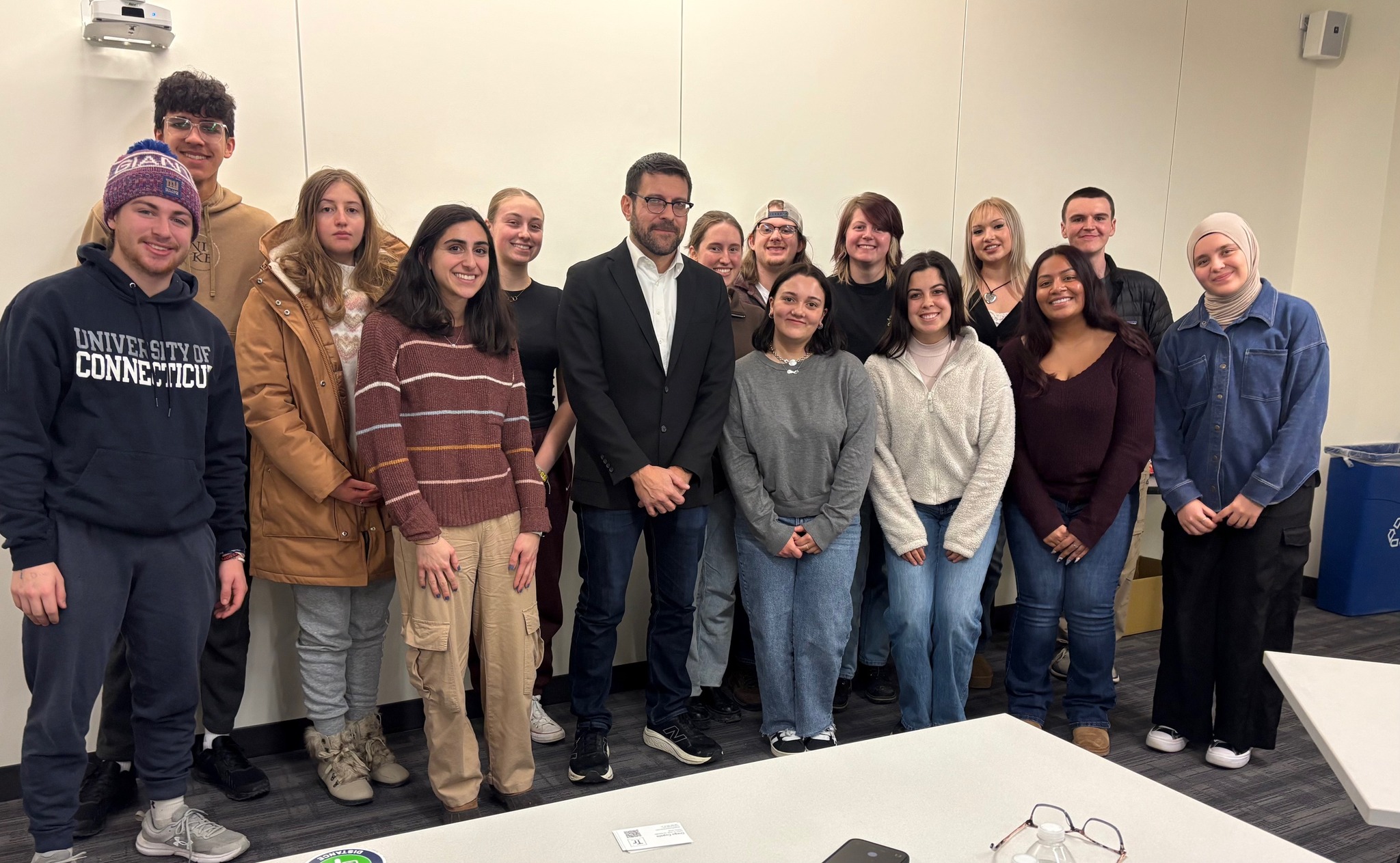
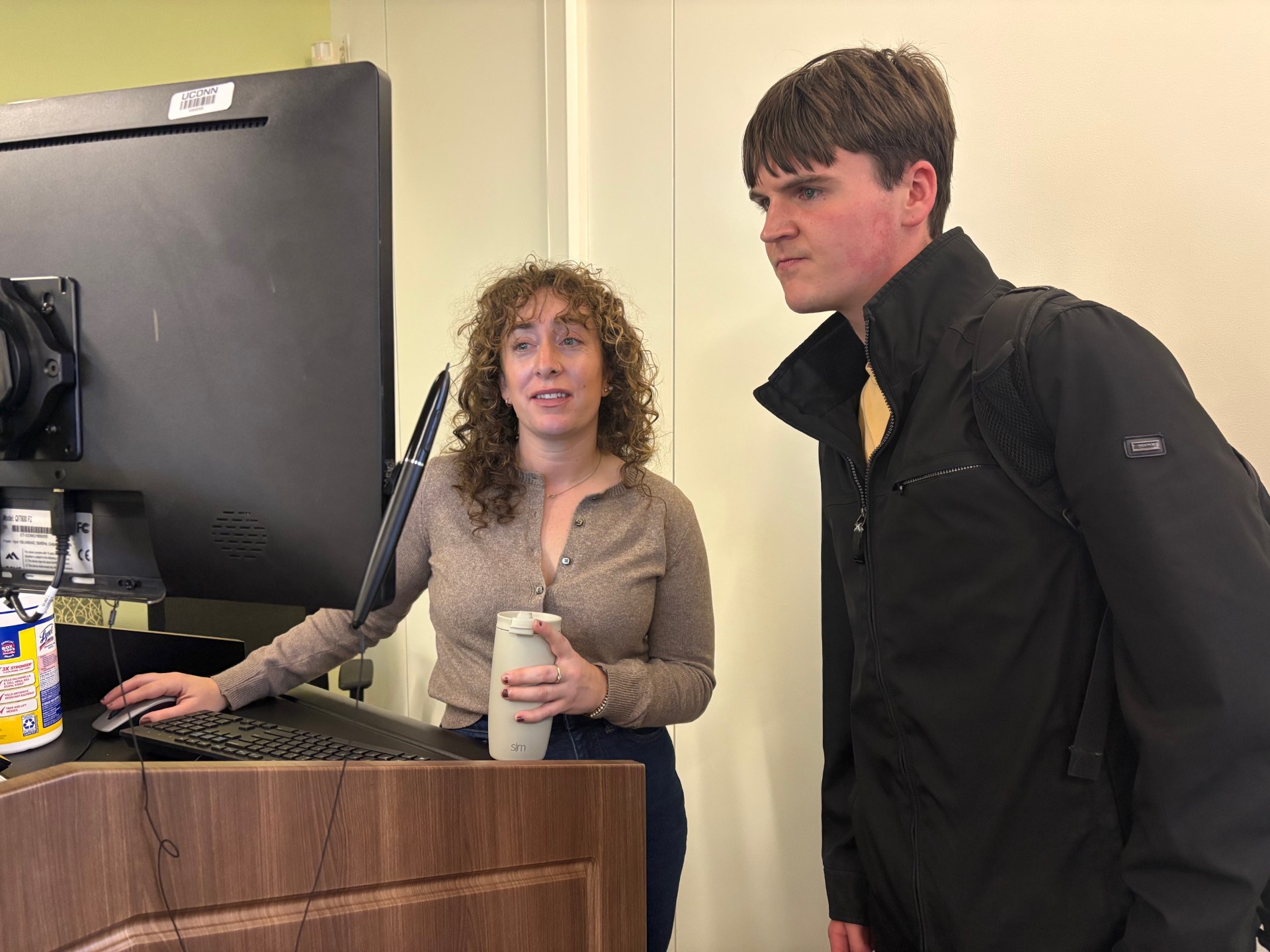
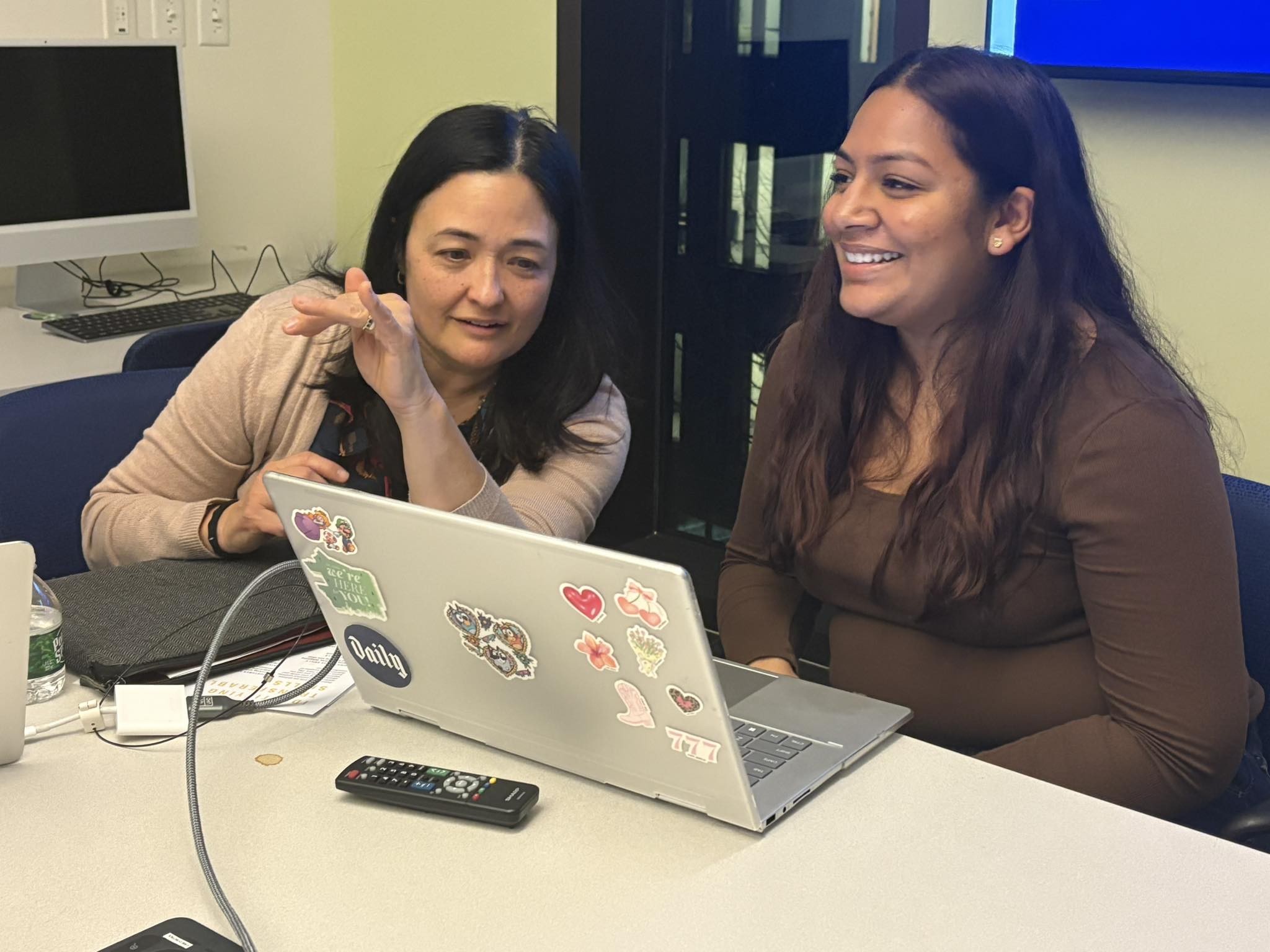
    She is pictured below with UConn SPJ members and students, and UConn SPJ President Sara Bedigian and Vice President Dan Stark. Photos by UConn Journalism major Mia Palazzo.