News

Once novelty, now necessity: Journalism alumni share their favorite technology and apps that got them through the pandemic

 Headshots of UConn Journalism alumni
UConn Journalism alumni tell us about the tech that helped them get through the pandemic. On the left, Eric Ferreri and Zac Boyer; center, Purbita Saha; on the right, Jeremy Kohler and Grant Welker.

The COVID-19 pandemic brought out new forms of resilience in journalists. While the world retreated to houses and apartments, public life closed, and traditional ways of finding people disappeared, reporters found that technology provided a crucial line of communication to sources and coworkers. It made the difference between getting work done and not getting it done, in many cases.We asked UConn Journalism alumni and faculty to name their favorite app, program, or technological gadget that allowed them to keep working through the pandemic. The answers range from methods to do reporting to methods that save or transmit documents and data.

Prof. Maureen Croteau, the outgoing department chair, said her favorite tool is Scanner Pro, a scanning app that allows sending documents electronically. What once might have seemed like an alternative method of sending something evolved into a necessity during the pandemic.

For Grant Welker ’06, a projects reporter for the Boston Business Journal, the technology he could not do without was Google Sheets. “Especially as a business reporter and particularly during the pandemic, there have been lots of cases of coming across huge spreadsheets that needed to be quickly combed for data or simplified and cleaned up for use with a story,” he said.

He learned how to use Google Sheets from a class taught through the New England First Amendment Coalition. A few weeks ago, Welker said he “relatively very quickly went through a national database to find more than 2,500 restaurants in Massachusetts that received federal pandemic aid.” He had done a similar exercise in his previous job at the Worcester Business Journal in a series that covered Paycheck Protection Program loans and grants in Central Massachusetts, and an earlier story tracking prescription opioids.

Pandemic or no pandemic, 2008 graduate Zac Boyer, NFL editor at The Athletic, said his favorite technology has always been his digital recorder—his Sony, not his smart phone. “Call me old-fashioned,” Boyer said. “I just don’t think it’s professional enough.” He added, “Having the ability to convey what someone says accurately is a pillar of our industry, and there’s no better way to do that than with a tape recorder. That may be basic, but I’ve found that allows me to have a better conversation with a subject or a source than it would if I was just jotting down notes that I might get wrong, too.”


Programs
Zoom, Microsoft Teams, scanning apps, Google Sheets, Blue Yeti Microphone and Otter.ai transcription software, were among the favorite tools of UConn Journalism alumni and faculty during the pandemic.

With newsrooms and studios closed everywhere, journalists’ homes became recording studios for podcasts and interviews. Purbita Saha ’12, a senior editor at Popular Science, said her favorite tool during the pandemic was hardware. “Popular Science gave me a Blue Yeti Mic before the pandemic for occasional guest spots on our podcast, ‘The Weirdest Thing I Learned This Week.’ But now with the microphone, I can turn my drafty apartment into a makeshift audio studio for podcast recording, Zoom webinars, social media, and more.”

Saha said her web cam is terrible but her voice always sounds good for interviewing and connecting with colleagues and online readers.

Reporters have for more than a century relied on telephone calls, but apps that allow calls over computers may have truly come into their own in 2020 and 2021. ProPublica reporter Jeremy Kohler, who graduated in 1994, said iOS TapeACall and Otter.ai, a transcription app, “have been life changing. Being able to quickly transcribe interviews, news conferences and livestreams, has been a huge timesaver and has allowed me to get great quotes, relying less on notes and memory.”

Kohler believes that when he can record interviews, that frees him to do do a better job interviewing. “Worrying less about note taking lets you use all of your brain to ask better questions and control the flow of the interview,” he said. “I’m not sure how I survived this long without them.

Associate Professor Scott Wallace, who reports on indigenous people in South America, said he too puts a phone app first on his list of crucial technology. “This probably sounds kind of antiquated,” Wallace said, “but I’d say without a doubt that for my current project in Brazil, I am using WhatsApp more than anything else.” He said that groups in Brazil keep track of indigenous and environmental issues in Brazil using WhatsApp. “I use it to communicate with Brazilian contacts quickly by text, audio messaging or voice calls.”

Connecticut freelance journalist Jamiah Bennett ‘20, author of a recent piece about the first Black anchor in Connecticut, said she relies the most on her laptop computer. It might seem to go without saying, but imagine living through a pandemic without this basic piece of equipment.  “In terms of technology, I rely on my cell phone and laptop the most. On my phone, I use Instagram, Facebook, and Spotify the most,” Bennett said. “On my laptop, I rely on Google Chrome the most. My favorite piece of technology is my laptop.”

Eric Ferreri, who graduated in 1995, said Zoom for virtual meetings and Microsoft Teams for sharing documents were “crucial” in his work as senior writer for Duke University Communications. Those two programs “became everyday tools to communicate with my team from afar. Zoom isn’t flawless, but it’s easy to learn and use. Teams can be overwhelming because it does so much, so you use it for what you need.”

Ferreri added that he became hooked to the apps that allow ordering food online and picking it up without interacting with anyone.
Reported and written by Christine Woodside, Visiting Assistant Professor in Residence.

Filmmaker Martine Granby joins Journalism faculty and Africana Studies Institute

Martine Granby is a filmmaker who will hold a joint appointment in Journalism and Africana Studies at UConn.

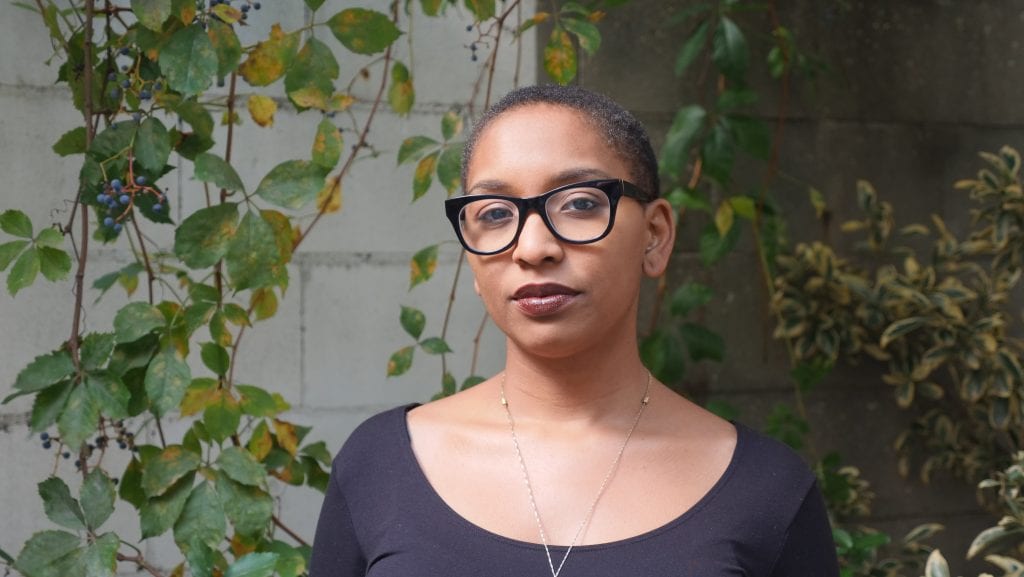
Documentary filmmaker Martine N. Granby has joined the Department of Journalism as an assistant professor. She holds a joint appointment in the Africana Studies Institute, and is an affiliate of UConn’s Women’s Gender, and Sexuality Studies Program.

She has worked as a documentarian, producer, editor, video journalist, and educator for The New York Times, Kartemquin Films, The New School, City Bureau, BRIC TV, UnionDocs, and Global Girl Media, an organization empowering young women with the tools for visual journalism to tell their own stories.

Granby’s films weave between documentary, experimental non-fiction, hybrid, and essay forms. Her creative research focuses on interrogations of and material experimentation with family and collective moving image archives, ethical considerations of found footage usage, discourses around mental health in BIPOC communities, and the narrative residues of pop culture in personal memories/viewership.

“I’m beyond thrilled to meet and work with the students and faculty in both the Journalism department and my joint-appointed home in the Africana Studies Institute,” Granby said. She will relocate from Brooklyn, N.Y. and be in residence on campus in Storrs this fall, doing occasional guest teaching. She will begin teaching her own courses in spring 2022.

Her teaching focuses on technical film training and observational critique pulling from diverse film, video, journalistic, and media arts samplings that include but go beyond the traditional canon.

She received her bachelor’s degree in sociology and film studies from Mount Holyoke College and earned a master of arts from Northwestern’s Medill School of Journalism.

“Some of the best advice I received while in graduate school was not to compare yourself to your peers,” Granby said. “We are all learning together, and everyone brings something different to the table. Honor your own eye and point of view in this field.” In 2015, Granby and a group of her fellow black female documentary filmmakers formed the coalition Brown Girls Doc Mafia.

Her current project is a short film that is part of a three-film series on access to and barriers against mental health care in Black communities. Her earlier work includes a feature film, “The Mask that Grins and Lies,” a personal essay portrait of intergenerational silence around women’s mental health in her family.

This fall she will premiere a documentary short co-directed with Shirin Barghi for Brooklyn-based BRIC TV. It covers the history of New York City’s oldest women’s motorcycle club: “its place in queer history, the lives of its members, and the sisterhood of a chosen family,” she said.

Her teaching goals include teaching about the shifting landscape of film production, to encourage students to ask questions about how they interact with their subjects and audience, and helping students look at media in new ways.

“Students must approach my class as members of a collaborative, democratic, and generative environment,” she said. “We create a collective space in which students shape, share, and strengthen their journalistic and filmic voices.”

Granby added, “Budding documentarians and video journalists must learn how to articulate the choices behind their work, and learn to examine how the media they create is received, ingested, and impacts the surrounding polity is an essential part of the documentary practice.”

Caroline LeCour ’22 (CLAS) is reporting from NBC CT

Caroline LeCour’s journalism experience at UConn, and her persistence, helped her land a remote internship at NBC CT this summer.

Name: Caroline LeCour ’22 (CLAS)

Hometown: Old Lyme, Connecticut 

Major: Journalism and communication 

Internship: NBC Connecticut’s Digital Team 

How did you find this internship? 

I knew this past spring that I wanted an internship, so I applied everywhere I could as early as mid-February. I am looking to get into on-air reporting, so I applied to a lot of local news stations around Connecticut and in neighboring states. However, due to the coronavirus pandemic, a lot of internships for broadcasting stations were either cancelled or postponed to the fall. Around mid-April, when I thought all hope was lost due to all the cancellations, the head of NBC Connecticut’s Digital Department, Brad Luck, reached out to me to see if I was interested in interning remotely for his team. I interviewed for the position and shortly after found out I was accepted!

Read more at UConn Today »

Trajectory: Juliana Mazza ’13, live from Boston

Juliana Mazza in the WHDH 7 studio
Juliana Mazza ’13 is a UConn Journalism alumna who now reports and anchors the news at WHDH 7 in Boston.

Being a TV news reporter is hard. It’s not just the insane hours, rising at 2 a.m. to work the morning shift, or missing important weddings and birthdays, or never having the same days off as your partner, or being told by hurtful trolls on social media that you need to lose weight or change your hairstyle — right after you just got back from covering a blizzard where you were pelted in the face by snowflakes the size of chicken pot pies. But the most difficult part, says Juliana Mazza ’13 (CLAS), reporter and morning anchor at WHDH 7 in Boston, is being human.

“It’s really hard, meeting people at the lowest moment in their life, where they’re facing unspeakable tragedy, somebody who is on their knees in tears, and it’s your job to talk to them.”

Sometimes you hold the mike, and sometimes you hold the person.

Read more from UConn Magazine »

UConn Is Again a National Leader in Fulbright Scholars

The Fulbright Program is the government’s flagship international educational exchange program. UConn faculty scholars include: top Row (L-R): Amanda Denes, Damir Dzhafarov, and Michael Lynes. Bottom Row (L-R): Anne Oeldorf-Hirsch, Marie Shanahan, and Steven Wilf.

The University of Connecticut has been recognized among the top producers of Fulbright U.S. Scholars from research institutions for the third time in the past five years.

The University has seven Fulbright Scholars on its faculty who were given the opportunity to teach and perform research around the world in the 2020-21 academic year, according to the U.S. Department of State’s Bureau of Educational and Cultural Affairs.

The national leaders were featured in The Chronicle of Higher Education on February 15. UConn is tied for ninth nationally on that list.

Associate professor of journalism Marie Shanahan is among the UConn faculty offered Fulbright projects abroad. She will conduct research at Leyte Normal University in the Philippines to determine how news organizations are combating – or contributing to – the online spread of inaccurate or deliberately deceptive information under the guise of news.

Read more on UConn Today »

Q&A: Trump, the Capitol, and Social Media

Social media played a significant role in the storming of the U.S. Capitol, and its influence in shaping American politics is unlikely to wane, says UConn's Marie Shanahan.

On Wednesday, Jan. 6, following a speech by President Donald Trump at a rally dedicated to the false claim that he won the presidential election in November, a large crowd of his supporters stormed the U.S. Capitol, leaving five dead – including a Capitol police officer – and causing damage throughout the building that serves as the seat of representative government in the United States.

Although the images from the Capitol were shocking, the event itself was partly the product of an atmosphere of paranoia and anger that had been building for years, primarily on social media. Two days after the Capitol was stormed, Trump and many of his supporters were banned from a number of prominent social media platforms, including Twitter and Facebook. This in turn led to accusations that a handful of powerful private companies effectively control public discourse in the United States.

Associate Professor of Journalism Marie Shanahan '94, who won awards as a reporter and editor at the Hartford Courant before joining the UConn faculty, is an authority on the rapidly shifting online media landscape. Her 2018 book, “Journalism, Online Comments, and the Future of Public Discourse,” grapples with many of the questions being asked in the aftermath of the storming of the Capitol. She recently spoke with UConn Today about the role social media plays in shaping American political life – in ways both good and bad. The conversation has been edited and condensed for clarity.

While obscure social media platforms like Parler, Gab, and Telegram have gotten a lot of attention recently as gathering places for the kinds of far-right activists who were instrumental in what happened at the Capitol, most of the planning for that event seems to have taken place in the open, on sites like Facebook and Twitter. To what extent was this event a product of social media?

Social media can tap really quickly into the power of the crowd. That’s what it’s good at. You can’t blame it for causing an insurrection, but social media certainly can play a role in accelerating one. Thanks to the Internet, we all now have the ability to interact constantly. People don’t have to be concerned about geographical distances or time differences, because now you can directly communicate all the time with people all over the world, and they can communicate with you. So you have this active, participatory culture online, but it doesn’t necessarily stay online. An idea for a protest, a political rally, or even what we saw on Jan. 6, can move out of the online space and into real life.

But the mainstream media is also responsible in some ways. People are gathering in these obscure corners of the Internet to plot armed marches, but I recently read a New York Times story that detailed those plans in the first three paragraphs. Maybe these people are on the fringe, but as soon as it gets picked up by the mainstream media, it becomes part of the larger discourse. I’m not sure journalists think enough about their ability to amplify.

Read more on UConn Today »

UConn Graduate Lauren Stowell Tells Inspiring Stories Through Eyes Of ESPN

The first time Lauren Stowell ’06 walked into a television production truck, she knew this was how she wanted to make a living.

The first time Lauren Stowell ’06 (CLAS) walked into a television production truck, she knew this was how she wanted to make a living.

“It was organized chaos, and you could cut the tension with a knife,” says Stowell, who was working as a runner for ESPN that day for a UConn basketball game when she was a student. That meant she was doing every little odd job the ESPN crew needed during their time in Storrs.

“I remember looking at the producer and the director in front of the board calling camera shots. There were graphics people yelling. It was the most chaotic, but beautiful, orchestra of madness I ever experienced. When I went home, I told my dad, I am not sure what I just experienced, but I want to be doing that.”

Stowell knew about sports at an early age, as her father, Bob Stowell ’71 (CLAS), was a UConn football student-athlete and then a long-time photographer at Husky events.

Lauren Stowell, who graduated with a degree in journalism with a concentration in pathobiology, is now a features producer at ESPN and a five-time Sports Emmy Award winner.

Read more at UConn Today »

‘Learn by Doing’: Journalism, ARE Departments Team Up for New Dual Degree

harvesting beans
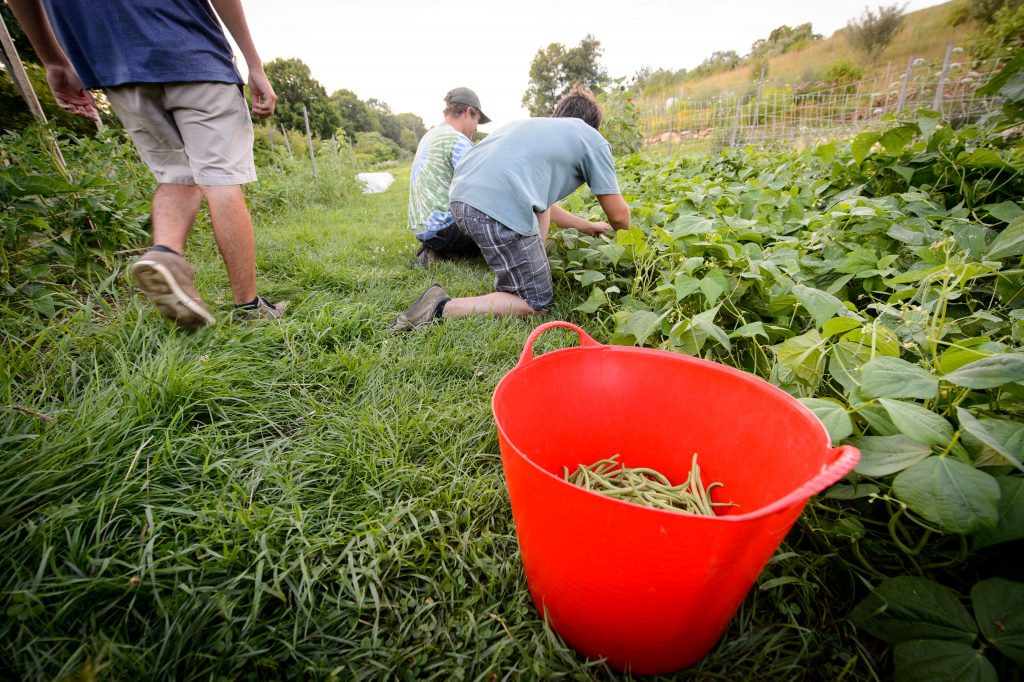
UConn’s departments of journalism and agricultural and resource economics have together created a new dual-degree program aimed at helping journalists specialize in agriculture, economics, and related policy areas.

UConn’s Department of Journalism and Department of Agricultural and Resource Economics (ARE) have worked together to develop a dual-degree program that allows students to simultaneously complete with a bachelor of arts in journalism and a bachelor of science in ARE. The  dual degree was created in response to requests from journalism students interested in pursuing ARE as an additional area of study. The new program allows students to gain experience in applying journalistic perspective to economics, the environment, and related policy.

Emma Bojinova, a lecturer in ARE, and Maureen Croteau, professor and head of the Department of Journalism, worked together to formalize a plan of study for the program that allows completion of  both degrees in four years while leaving room for electives and the fulfillment of all general education requirements. 

Read more on UConn Today »

For Scott Wallace, Remote Learning Means Getting Off the Beaten Path

inteviewing
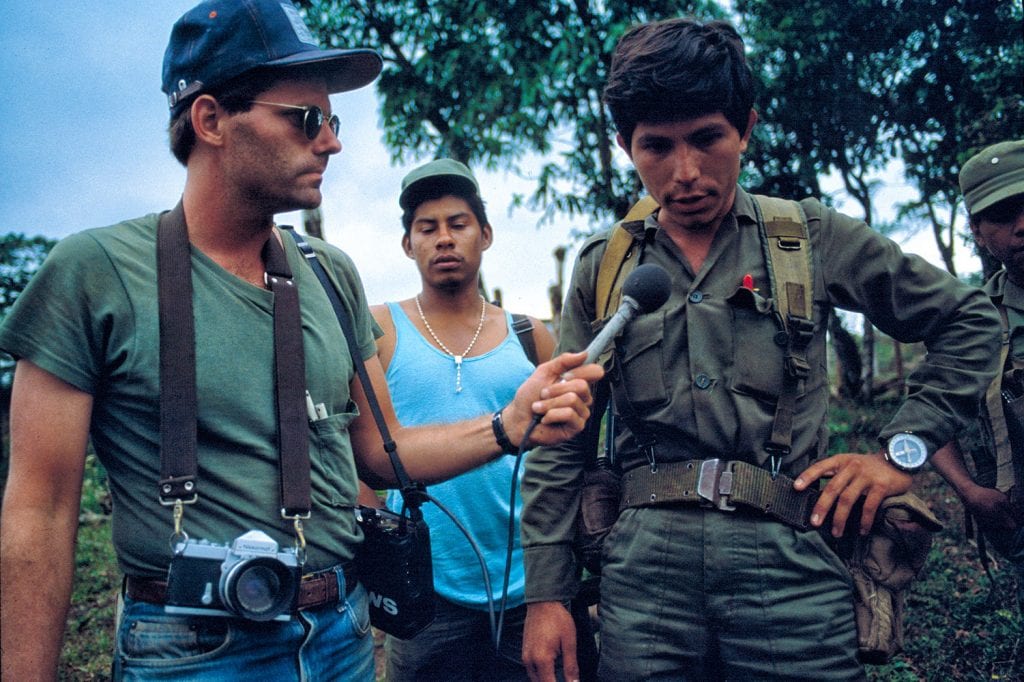
Scott Wallace interviewing an officer from the Sandinista Popular Army in Nueva Segovia, Nicaragua, 1984. (Photo by Bill Gentile)

Most kids who spent childhoods thumbing through the pages of the canary-yellow-framed National Geographics on their coffee tables, marveling at titular photos of exotic people and places, only imagined a day when they’d travel the world and see their own names attached to such stories and photos. Scott Wallace made it happen. Actively into his fifth decade of reporting, writing, and shooting stills and video for not just National Geographic but Smithsonian, Travel & Leisure, Harpers, and the like, the journalism professor illustrates his trade secrets and advice to students with real-life narratives that sound straight out of a big-screen blockbuster — one in which the pursuit of truth and justice is filled with as much trauma as triumph.

Telling us how he uses these exploits to illustrate the tenets he most wants to impart to his students, Wallace checks himself. “I don’t want to spend a lot of time talking about my own career, but I think I do have a rich trove of experiences to draw on.”

It’s an understatement. Wallace has traveled on assignment to the remotest of remote places on Earth and had a career most storytellers and adventurers only dream of. His recantations arrive humbly, however, with thoughtful pauses, counter questions, and intellectual insights that serve to remind he’s usually on the other side of the interview.

Read more from UConn Magazine »

A student-run newsletter aims to inform Connecticut voters, especially first-timers, what to expect at the polls and on the ballot on Election Day

A CT logo in the shape of a postage letter.
The logo for 'Crash Course' an election 2020 newsletter for first time voters in Connecticut produced by UConn Journalism students under the direction of Associate Prof. Marie Shanahan.

As the 2020 U.S. Presidential election and the COVID-19 pandemic collide, voters face new challenges, including how to cast their vote and where to find reliable information.

This semester, UConn journalism students launched Crash Course: Election 2020, a digital newsletter created to provide non-partisan information for voters about their choices come Election Day.

They aim to cut through the noise to help young and first-time voters learn what’s at stake on their ballot, and why it matters.

“We put an emphasis on neutral and truthful perspectives, so there’s not a political outcome we’re going for,” says Allison O’Donnell ’20 (CLAS), a journalism major with a political science minor who is one of the writers. “We want people to make well-informed decisions and give them the knowledge they need to make an informed vote.”

The digital newsletter focuses on a new topic each week, mixing national and local headlines, including student debt, the Supreme Court, environmental issues, political debates, and more. The newsletter is part of Associate Professor of Journalism Marie Shanahan’s publication practice course on election coverage, and includes O’Donnell, Ashley Anglisano ’20 (CLAS), Fiona Brady ’21 (CLAS), Ben Crnic ’21 (CLAS), and Mike Mavredakis ’22 (CLAS) as writers, with Shanahan as the editor.

Read more on UConn Today »