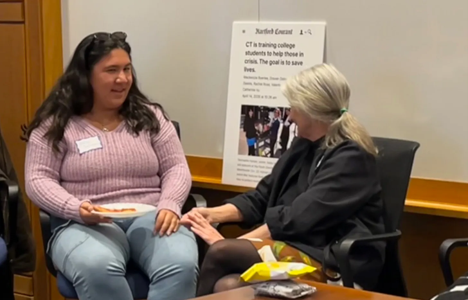
Journalism majors in the Spring 2026 Publication Practice course led by Associate Professor in Residence Julie Serkosky worked on a Solutions Journalism Network grant funded project that took a deep dive into aspects of mental health on campus. The advanced course (JOUR 4016) was part of the Solutions Journalism Network’s 2025-26 Student Media Challenge cohort through the nonprofit Connecticut Student Journalism Collaborative.

Serkosky, UConn Journalism Department Head Marie K. Shanahan, Assistant Professor Kate Farrish and Adjunct Instructor Harriet Jones are among the co-founders of the collaborative. Jones serves as its editor.
National research shows that the number of young people in the U.S. experiencing serious mental health challenges has been on the rise for more than a decade. Serkosky and her students received training on the rigorous Four Pillars of Solutions Journalism and sought to find campus programs and initiatives that were working to address these challenges. Every story involved discussion and advice from national Solutions Journalism Coordinator Sharon Bloyd-Peshkin.
Mikayla Bunnell, a junior journalism major, focused her reporting on pet therapy, which has grown in popularity at UConn and other universities in recent years. Her story, Dog therapy catches on at UConn, other colleges across the U.S., was published by CT Community News and republished in the Hartford Courant and the CT Examiner.
Bunnell was most excited about the hands-on nature of building a solutions story, attending therapy sessions and observing interactions.
“I spent a lot of my time listening rather than asking questions,” she said. “I got first-hand experience with the solution I was writing about, which I think helped me explain the concept better and benefited my story overall.”
Senior Gianni Salisbury said she had to do extensive research to nail down her story about student bereavement.
“For this story, I had to talk to experts for inspiration first because the solution was not obvious or previously reported on,” Salisbury said. “It was something I had to find and something only people in the field of grief and college policy knew about.” The resulting story, Grief, loss and the college student, explains that up to 44% of college students experience the death of a loved one during any two-year period in school.
The solution highlighted formal student bereavement policies that can guide those who are grieving and help support them as they continue their education.
Senior Sara Bedigian followed these principles in her story on Sandy Hook survivor Audrey Nichols, who is striving to pass gun violence prevention legislation.
“When I conducted the interview with Audrey, it was challenging but I used the narrative techniques we discussed, which helped,” Bedigian said. “I have not interviewed someone before who had experienced the trauma she did. When I told her about the solutions lens and how I am going to focus the story on her advocacy, it made the story easier for me to tell and for her to open up and share.”